Blog

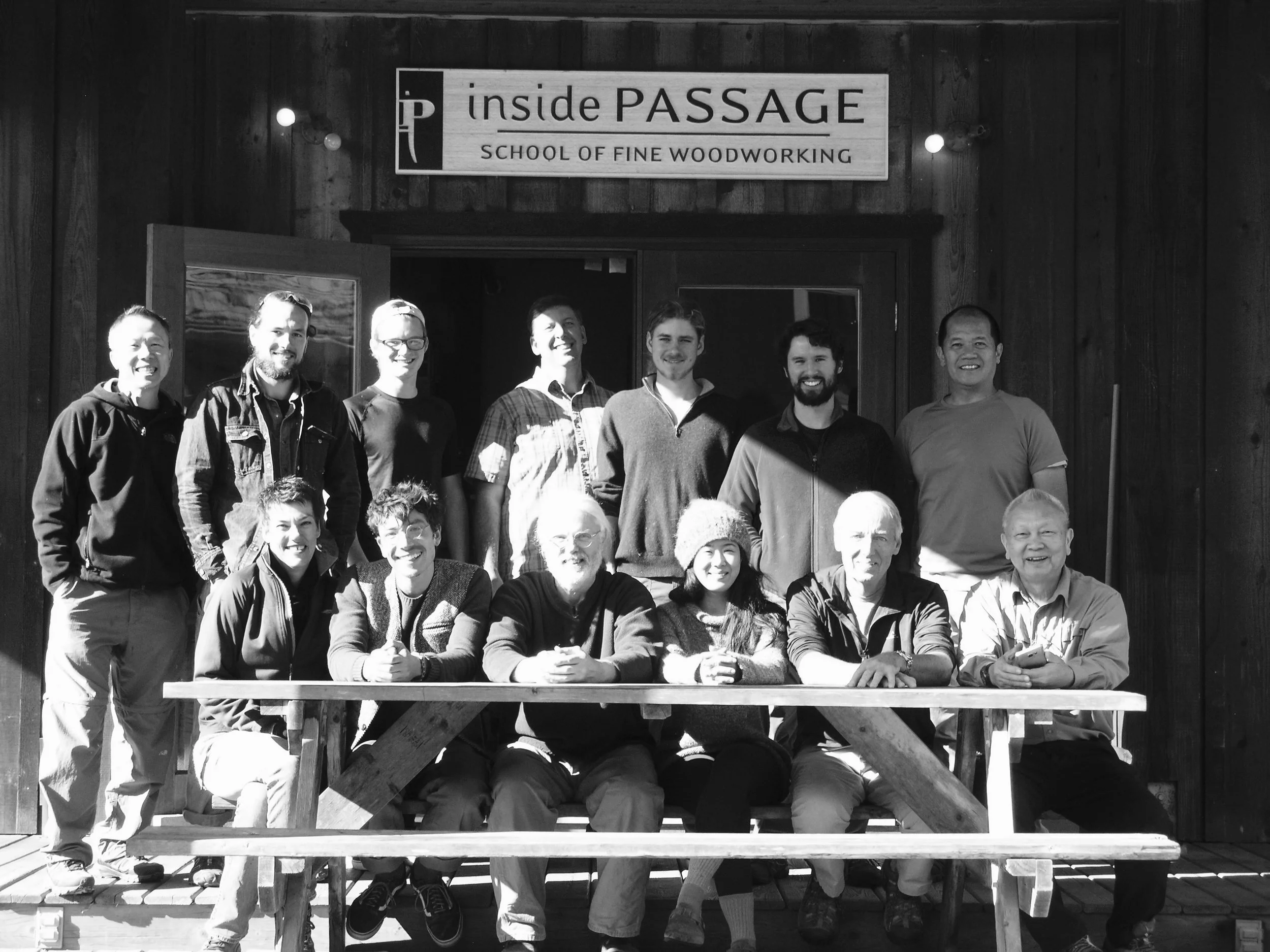
  • Fall 2018

     Fall 2018
    Fall 2018

    COMPOSING

    Andre Plante – Canada
    Brett Almey  – Canada

    VIDARS CHAIR

    Chung Leong Tang  – Malaysia
    David Stevens – United States

    IMPRACTICAL STUDIES

    Benny Miscavage – United States
    Travis Gran – United States
    Ted Boey – Canada
    Steve Wright – Canada

    ADMISSIONS & STUDENT SERVICES

    Yvonne Van Norman

    RESIDENT CRAFTSMEN & TEACHER

    Robert Van Norman

    RELIEF TEACHER

    Gary Kent

  • Refeal Greenblatt – Israel

     A fine craftsman and very sweet man:)
    A fine craftsman and very sweet man:)

    Morning. I open the wall cabinet hanging in my room, a cabinet that was my first big undertaking. A wave of a fresh lemony smell, Port Orford Cedar. I open a drawer, sweet and pungent Olive… And with the smell a deep nostalgie. A time of devotion. Forest and ocean. A master and his family, fellow students on the path. Full days that are exhilarating and draining. Intriguing wealth of knowledge. Excitement and success mixed with fear and despair. Hands looking for their right position and starting out as a child again, to eventually, finally, taste mastery.

    Inside Passage will change you. For better or worse, that’s up to you. Everything is given – the wood, the experience, the huge heart. Close your heart and it will be your adversary, will manifest your unravelled knots, disappoint, and will worry you and those around you. Open and it will carry you, will be an anchor to rely on, a wonder and a delight, and so you will become a better version of yourself. You will get a chance to love.

    It’s not going to be easy. Yet it is the easiest thing to do. It will kick your ass, and it will hug you and be a home. It’s real. Accept the challenge, listen, be humble and try your best. You will fall, because you’re human. You can get up – everything is available here for you to do so, even if it’s not perfect, as you aren’t. Before you know it you will have an arsenal of tools, techniques and approaches that are rare, that take folks decades to figure out, if at all. That’s what it feels like to be part of a tradition, a belonging that can run through your emotion as much as it does through your mind and hands.

    I don’t know what I would have been without Inside Passage. I know that it has shaped me further than I can explain, and I gave it what I could. I walk in the world as a different man. For that, all I feel is gratitude.

  • Andreas Pfister – Munich Germany

    More than 3 years ago, in May of 2015, I went for it the first time and flew to Canada. I didn´t really know what to expect. A lot of thinking and negotiation had proceeded that step, but the final decision was made when my friend Michael visited his sister Caroline, a teacher at the Inside Passage School, and brought me back a copy of Krenov‘s ”Impractical Cabinetmaker.”

    After reading ”Impractical Cabinetmaker”, I ordered more books by Krenov. I started trying out what I read in a cold and rough but charming community workshop in Munich. I made 2 or 3 pieces there and then I flew!

    The first term was hard: Everything in English, a high pace, long hours and many skilled people around. I had no training before that and had no scale for this kind of work: how flat can a handplaned surface even be, how square is square?

    Luckily Robert and Caroline were amazing, kind and patient teachers and the schedule was set up in a natural progression: starting with sharpening and tool preparation to plane-making (still one of the most enjoyable things about this approach at the school: working with tools you made) and onto a little cabinet that involved all the basic techniques that should sink in over the next sessions/year/a lifetime.

    The second term? Even harder, probably the hardest of them all!

    Starting off with a certain cockiness (being second term, having done things already once, 4 planes on the toolcabinet), in combination with absolute focus on the school and being side by side with students as motivated and eager as me resulted in regular 12 hour days and working throughout the weekend. It also resulted in the steepest learning-curve so far; pushing my own abilities to the max. Once again, Robert always made sure we would not get too crazy (…) and Caroline was always there with a good eye.

    The second term resulted in a beautiful 5 drawer wall cabinet, still one of my favourite pieces. And even though I went to Squamish after, I was too tired for world class climbing…

    I came back in spring of 2017, after a year of aquiring machines, setting up a small workshop in Germany and finding out I was simply not ready to work on my own. 

    For various reasons I would still consider the third term as being my easiest term. Although it didn´t feel like it, during the year I was working on my own in Germany, my handskills definitely improved and some movements and sequences became second-nature to me. 

    The chair term is pretty much laid out for you: there is a definite sequence of steps, all the angles and dimensions are there and allow you to focus on what this exercise can teach you: a thorough understanding of grain graphics and their possibilities. Every part of Vidar´s chair is carefully selected and rotated to give the best grain orientation that compliments its shape. While this is already important for cabinet work, an (even slight) deviation of pattern becomes even more obvious in the thin, fragile parts of a chair. 

    The second emphasis of the chair is joinery; joinery in all gradations. From ”simple” mortise and tenon joinery to mortise and tenon on an angle (..or on a compound angle.. or on a curve.. you get it all!) Still, as technical as it sounds (and sometimes is), the chair also gives you long hours with the spokeshave, the tool you will get most familiar during the third term.

    And then, suddenly, it was there: the composing term.

    Still not feeling ready for something of my own and having learned to appreciate the advantages a reproduction gives you in a school setting, I decided to attempt a Krenov piece I simply loved from the moment I saw it. (actually there are two that always stuck out for me browsing through the books, but more on that later.) It was a quite timeless, large cabinet, with two facets running down the front over the full height. The top was a showcase with V-shaped glass doors, all the parts veneered and the bottom doors matching the shapes of the top ones.

    Pretty soon I was set on some beautiful pieces of English Brown Oak donated to the school by an alumni who passed away less than a year earlier. The planks were purchased by Doug Ives when he was in his third year at the school. I was the very grateful to be first recipient of the scholarship on his name. I decided that I´d use White Oak for the inside of the cabinet, an  exceptional piece from Caroline.

    Because of the big surfaces of the piece, I spent the first weeks of the project just cutting veneers and making the lumbercore I needed. It soon became obvious to me that this piece was something  beyond what I´d ever made before. Veneer, a construction method I dismissed at first, became intriguing to me with this cabinet. But still, working with veneer feels oh so different! Even though it is shop-sawn and about 2mm thick, you have to work the surfaces with great care not to tear anything out. You are still able to work them as we do solid wood, but the tolerances are much tighter. 

    This piece and all its random angles that needed to match brought me close to a padded cell at times. The cabinet has travelled with me to Germany and I am making friends with it again, but back then it was a love and hate relationship.

    But, all this does not say anything about what I learned in this session! As challenging as it was, as many mistakes as I made (and repaired), I still –or maybe therefore– learned so much!  I learned about veneer construction and work drawings, about frustration and how to get through it (or rather knowing when to go home sometimes). I learned that it is hard to finish a piece sometimes, but also that one detail can suddenly get you excited all over again!

    In this case, this detail was the base or stand: the Krenov original sits on a closed base that neither Robert nor I ever really liked on my piece when we mocked it up: it worked on Krenovs, but on this piece something was missing. So, we started to play around with the possibility of feet. Suddenly the whole cabinet came to life; became light and graceful. This small change really pushed me through the last weeks.

    Another change and addition to the program started around that time: the so called „quiet Saturdays“. As nice as the machines in the shop are, there is a special mood when they don‘t run. It is quiet, everyone is relaxed and at times you just hear the very personal rhythm of hand tools. 

    Every Saturday starts with a Lecture of Krenov, picked according to the weeks topic from a number of phonecalls Robert recorded when the school started. 

    This sets the mood for the day, and when the decision was made to have no machines on Saturdays, this mood could be kept through the day. It means to think ahead and plan accordingly, to be set up for handwork on the weekend. But these Saturdays were some of the most enjoyable days in the shop!

    Because of the Doug Ives Scholarship, I was able to stay longer and complete another piece. I had my eye on another Krenov piece for awhile; a very different and quite unusual one. While it was still quite formal and clean, without many curves and lots of clean, crisp lines, it had a quite unusual open space on top of a biq, square corpus.

    More and more I liked the idea of this little open space that is part of the piece while also being a part of the room the piece stands in. It is a transition zone, of some sort, that invites you to interact while passing by. A small stage; a place to put fresh flowers, a picture or (as someone jokingly suggested) an aquarium.  

    Robert agreed that I could stay on for this piece, and I was so grateful, because everything came full circle! I never had so much fun working on a piece; I felt confident, even while repairing the (inevitable) mistakes. There was solid wood to work with again, and the small but important little steps, like shaping the legs to their slight rounding, it all felt just right. There was some veneering again, but I also enjoyed that. All the joinery was 90°, what a treat!

    The combination of wood in this piece made sense, they all go together so well. It could have been because I was just eying them over for such a long time, it could have been luck, but I know for sure that it also was Robert, whose eye for colours and memory of woods (and also just the sheer size of his wood collection) made it possible!

    I finished gluing the pulls on the doors about 5 minutes before the machines were turned off on the last day. Back then, now, and I guess, for a long time this piece will be a favourite. I am glad to have it around:  for its presence, for its colours, and as a reminder of what I am capable of and how it can feel. The cabinet is also a reminder of one of the happiest times of my life!

    Thank you Robert, thank you Yvonne and thank you Caroline for this experience and everything you taught me! I am about to set up my workshop again; this will happen because of you!
  • Asa Christiana – Portland Oregon

    Popular Woodworking Article

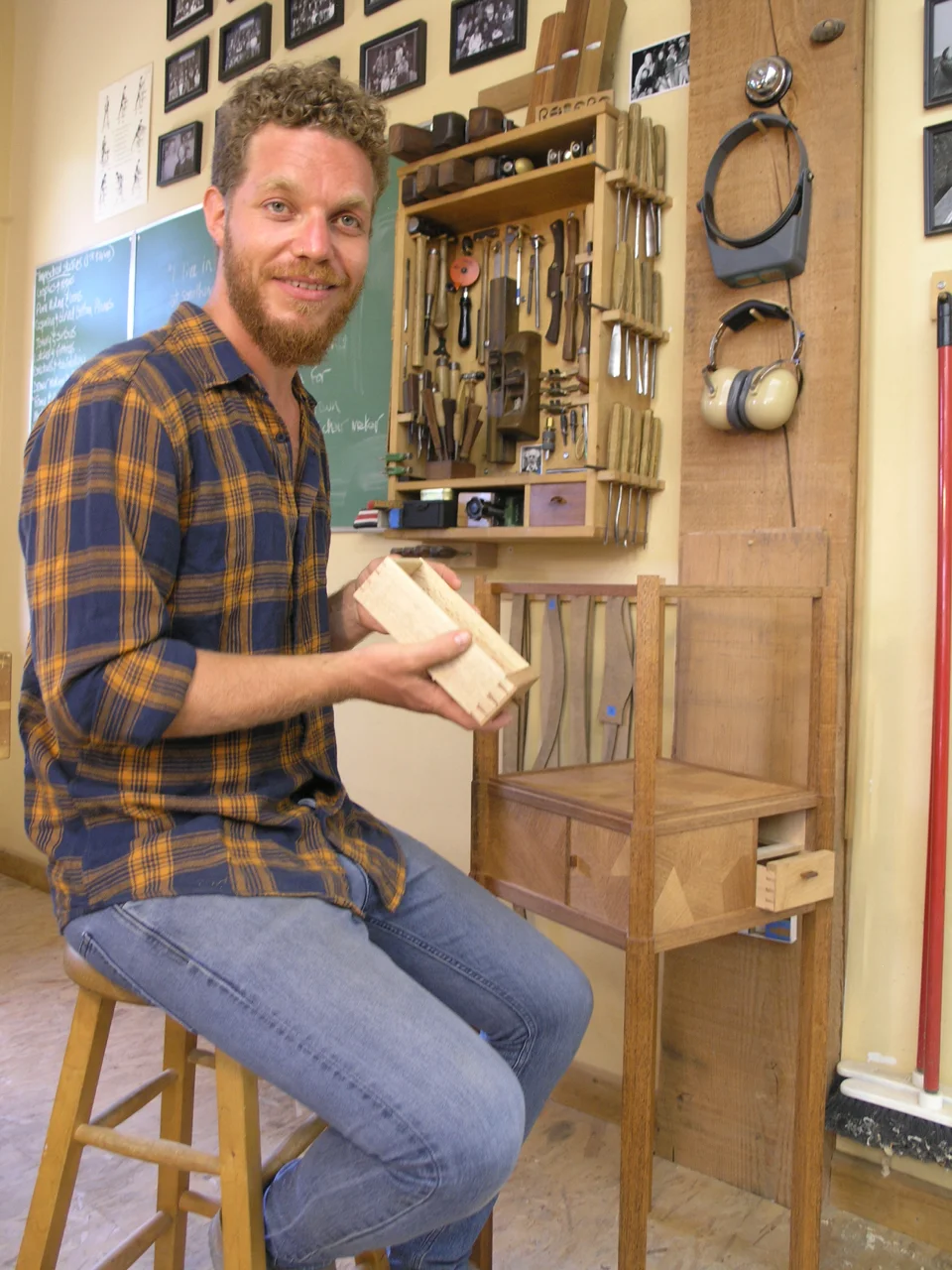
    Along with Sam Maloof, George Nakashima and a few others, James Krenov introduced America to the idea of the artist-woodworker. His books inspired a generation to approach wood furniture in a profound and organic way, and the cabinetmaking program he founded in northern California has turned out some of the most masterful makers worldwide. A couple weeks ago I traveled on assignment to a school northwest of Vancouver, where one of Krenov’s most talented and devoted disciples is carrying the legacy forward in an incredible way.

    As Krenov was winding down his career at College of the Redwoods, he was being discovered by maybe his most faithful follower. Robert Van Norman, who was teaching shop class to at-risk kids in Saskatchewan, had read “A Cabinetmaker’s Notebook,” Krenov’s first and most influential book, and like many was inspired to follow a similar path. He took a chance and called the iconic Swedish-American educator out of the blue.
    Known to be alternately crusty and warm, Krenov was nothing but encouraging to Van Norman and they struck up a friendship, talking often as the younger man left teaching and began working with a German cabinetmaker.

    But the work was commercial and unfulfilling, off the pure path Krenov had described, so Robert left to make original work. He did commercial cabinetry jobs at first, but soon found that his spec pieces were beginning to sell, like this beautiful double rocker.

    Van Norman lived in a series of homes and shops as he built a name for himself, while his ever-supportive wife Yvonne ran a home-cleaning business and helped raise their young family.

    Where the story gets really amazing is when Robert fell one day on the ice and permanently injured his back and legs (he recovered but has chronic pain). Looking for answers he re-read the foreword to “A Cabinetmaker’s Notebook,” in which Krenov mused about one day turning to teaching, when he was too old for “hoisting big planks” and other rigors of full-time furniture making.

    Van Norman decided to visit Krenov at College of the Redwoods, to finally meet him in person after 12 years of phone conversations. At the school, Robert and Jim hatched a novel plan. Already an incredible craftsman, Van Norman would attend the school for just one year instead of the usual two, with the intent of becoming a teacher in the master’s mold.  It took a tremendous family effort for Van Norman to attend CR, but he did it, and halfway through his year, they were already giving him CR students to teach.

    When Van Norman got back to Canada, he took a few unfulfilling teaching positions , eventually ending up at Rosewood Studio near Ottawa, as the school’s “resident craftsman.” His wife and kids made the move too.

    The school was a good one, but still not deep-dive program Van Norman was imagining, and he knew the only solution was to start his own. At the same time, Krenov was aging and being forced into retirement, and the cabinetmaking program he started at CR was changing direction slowly. He was captivated by Van Norman’s venture. In fact, Krenov donated every one of his machines, tools, and workbenches to Van Norman’s school, as well as his entire archive of slides and photos, many never before seen.

    In Robert Van Norman’s own shop, he has many of Krenov’s own machines, his workbenches, and his entire archive of slides and photos.

    In Krenov’s words:
    “It makes me happy that this small school intends to return to the traditional. To the values and no gadgets methods which have nourished our craft for a very long time. Dedication, a simple logic in what we do and how we do it. For some, there is a lure; mysteriously elusive wood, tools that follow one’s intention, an awareness that our craft is an intimately timeless education. If you feel even a bit of this… persevere. Enjoy. The journey may change your life.”

    What is just as beautiful is the place the Van Normans chose for the school. Northwest of Vancouver, B.C., in a remote section of coastline only accessible by ferry, they found the little town of Robert’s Creek, perched along the Inside Passage, Canada’s vast coastal waterway.

    There he and Yvonne bought a little homestead, adding a big mortgage to help build the school. In 2005 their perfect little building opened its doors with a beautiful bench room and nicely outfitted machine room, everything they needed to educate 10-12 students at a time. They have been full from the beginning, drawing students from 37 countries, most inspired by the same books that captivated Van Norman so many years ago.

    The story gets even more touching then. Krenov was much older now, losing his eyesight and realizing he would have to stop making cabinets. So Robert asked him to give weekly lectures to the students, over a speaker phone. He gave 300 hours of one-hour lectures to the students at Inside Passage, an hour a week, and they were legendary, ranging from the how to the why.

    When Jim died in 2009, Robert was devastated, and couldn’t bear to hear Jim’s voice for a couple years. Then he started using the lectures again, in a beautiful way.

    On Friday mornings at the school, Van Norman gives the floor back to Krenov, combining  snippets of the lectures with photos of Krenov’s work and a short Q&A. It is every student’s favorite part of the week.

    Students gather every Friday morning for a dose of inspiration and advice from the master himself.

    It hasn’t been easy for Robert and Yvonne, but their little school is the embodiment of Krenov’s philosophy and techniques, with Robert’s gentle manner and innovative ideas taking Krenov’s pure path ever higher.

    For the whole story, and a lot more pictures, see my upcoming article in Popular Woodworking magazine, and go to the school’s excellent website.

  • Summer 2018

     Summer 2018
    Summer 2018

    Residency

    Marion Couvreur – France

    VIdars Chair

    Brett Almey  – Canada

    UPWARD SPIRAL

    Matt Thornhill  – Canada
    Sam Gapic – Australia
    David Stevens – United States

    IMPRACTICAL STUDIES

    Geoff Munday – Canada
    Kerry Kyriacou – England
    Iain Rolfe – New Zealand
    Lev Winograd – Canada

    ADMISSIONS & STUDENT SERVICES

    Yvonne Van Norman

    RESIDENT CRAFTSMEN & TEACHERS

    Robert Van Norman
    Caroline Woon   

    TEACHING ASSISTANT

    Stephen Esdon

    RELIEF TEACHER

    Gary Kent

  • Spring 2018

    COMPOSING

    Andreas Pfister – Germany
    Marion Couvreur – France

    UPWARD SPIRAL

    Brett Almey  – Canada
    Matt Thornhill  – Canada
    Torrie Smith – Canada

    IMPRACTICAL STUDIES

    Dave Beauchesne – Canada
    Sam Gapic – Australia
    David Stevens – United States
    Mario Paredes Otalora – Spain
    Frank Bowles – United States
    Dave Giammarco – Canada  

    ADMISSIONS & STUDENT SERVICES

    Yvonne Van Norman

    RESIDENT CRAFTSMEN & TEACHERS

    Robert Van Norman
    Caroline Woon   

    RELIEF TEACHER

    Gary Kent

  • Winter 2018

    ADMISSIONS & STUDENT SERVICES

    Yvonne Van Norman

    RESIDENT CRAFTSMEN & TEACHERS

    Robert Van Norman
    Caroline Woon   

    RELIEF TEACHER

    Gary Kent

    COMPOSING

    Andreas Pfister – Germany – Doug Ives Scholarship
    Marion Couvreur – France

    Vidars chair

    Andre Plante – Canada

    UPWARD SPIRAL

    Torrie Smith – Canada

    IMPRACTICAL STUDIES

    Brett Almey – Canada
    David Glickerman  – United States

  • Heart

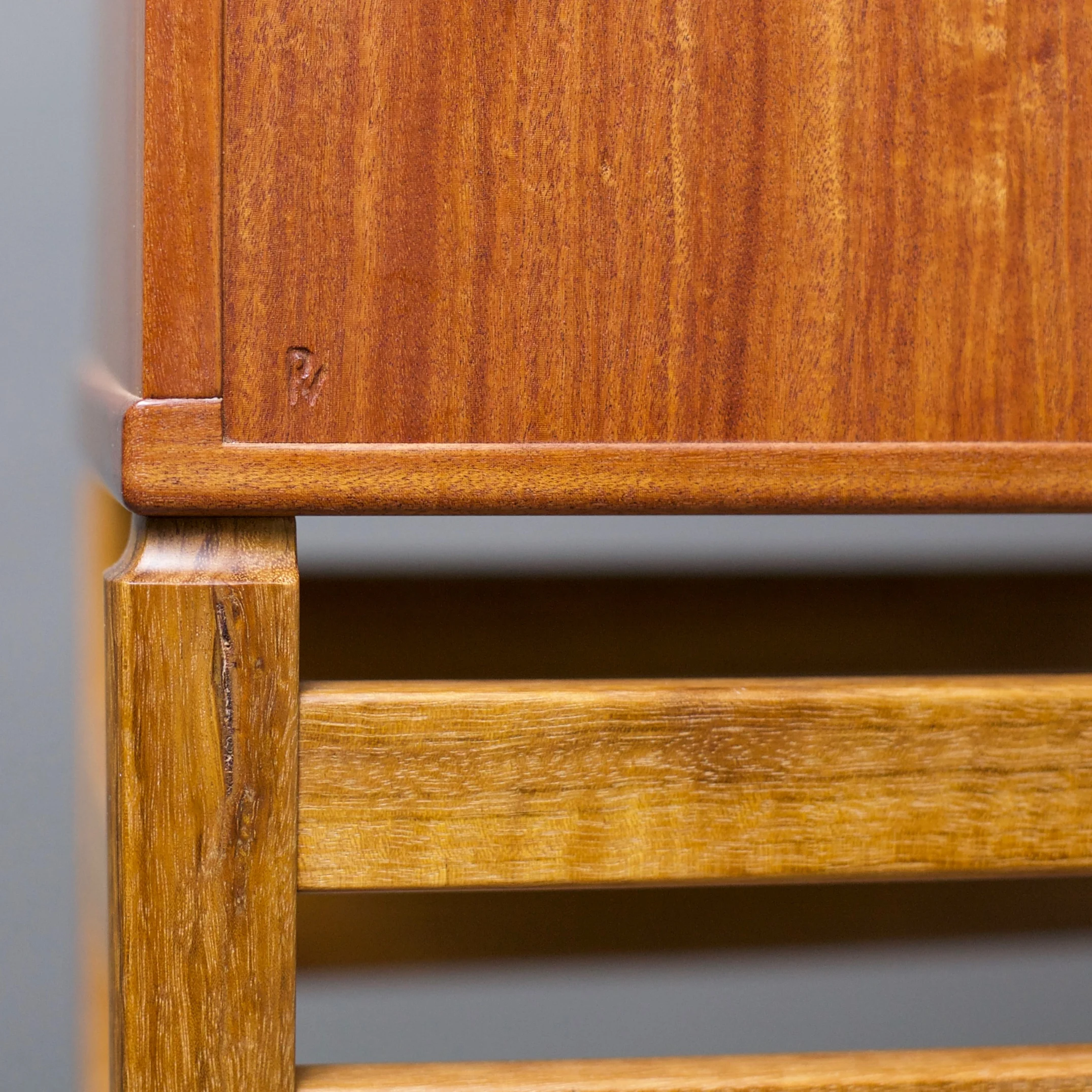
     RV 'Heart' cabinet by Robert Van Norman  photography by Tim Andries
    RV ‘Heart’ cabinet by Robert Van Norman photography by Tim Andries

    “What we need, is more heart in the work!” -JK

     impractical Cabinetmaker program fall 2017
    impractical Cabinetmaker program fall 2017

    This past week, we completed the fall term of our Impractical Cabinetmaker program. While students continue to enjoy 24/7 access to the school, this term we returned to our six day a week teaching schedule. Saturday is a special day at the school for me. We begin the day listening to one of Jim’s lectures and watching a slideshow from his archive. The rest of the day is dedicated to lectures that do not require machines and individual consults. Advanced program students and I have the opportunity to review their upcoming work and principle steps.

     Henry working on his sawhorses
    Henry working on his sawhorses

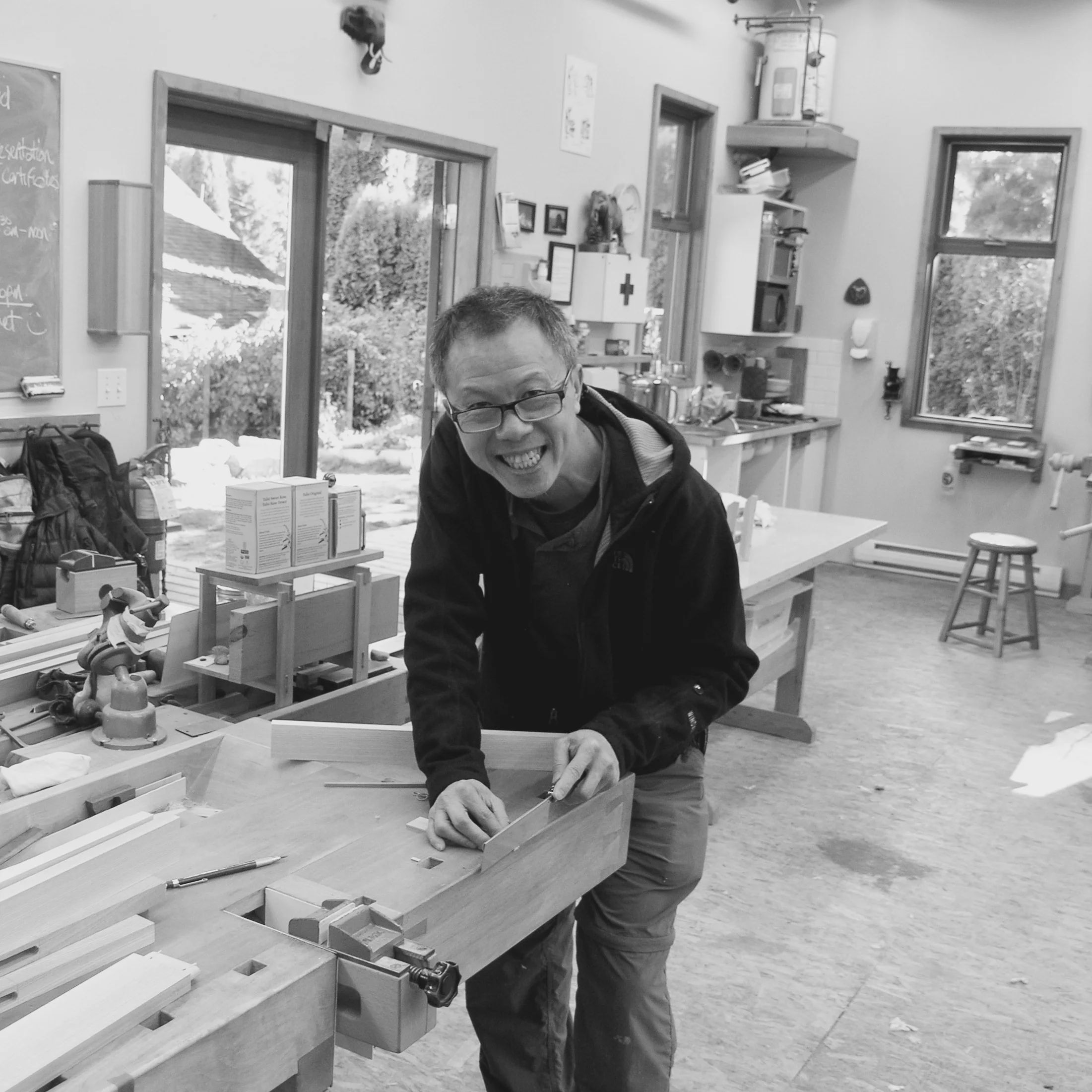
    During Henry’s first visit to the school he wrote a blog about his time here. I found out this term, that it was his blog that was responsible in part for for Tang first attending our school. I am so grateful for this and for the opportunity to work with such a lovely man.

     Georg flushing the frame of his back
    Georg flushing the frame of his back

    It has been such a pleasure to work with such a kind and gentle soul. I am so pleased that Georg intends to balance woodworking with gardening when he returns to Mexico following the program. Georg like many of our students was new to the craft. On the final day of the program, as I sat with a cup of tea on the porch. I watched Georg plane the surfaces of his curved veneered panel. The taping as he set the plane, the shavings that surrounded his bench and the smile on his face. I was filled with a deep sense of gratitude.

     Fu cutting the joinery for his drawer
    Fu cutting the joinery for his drawer

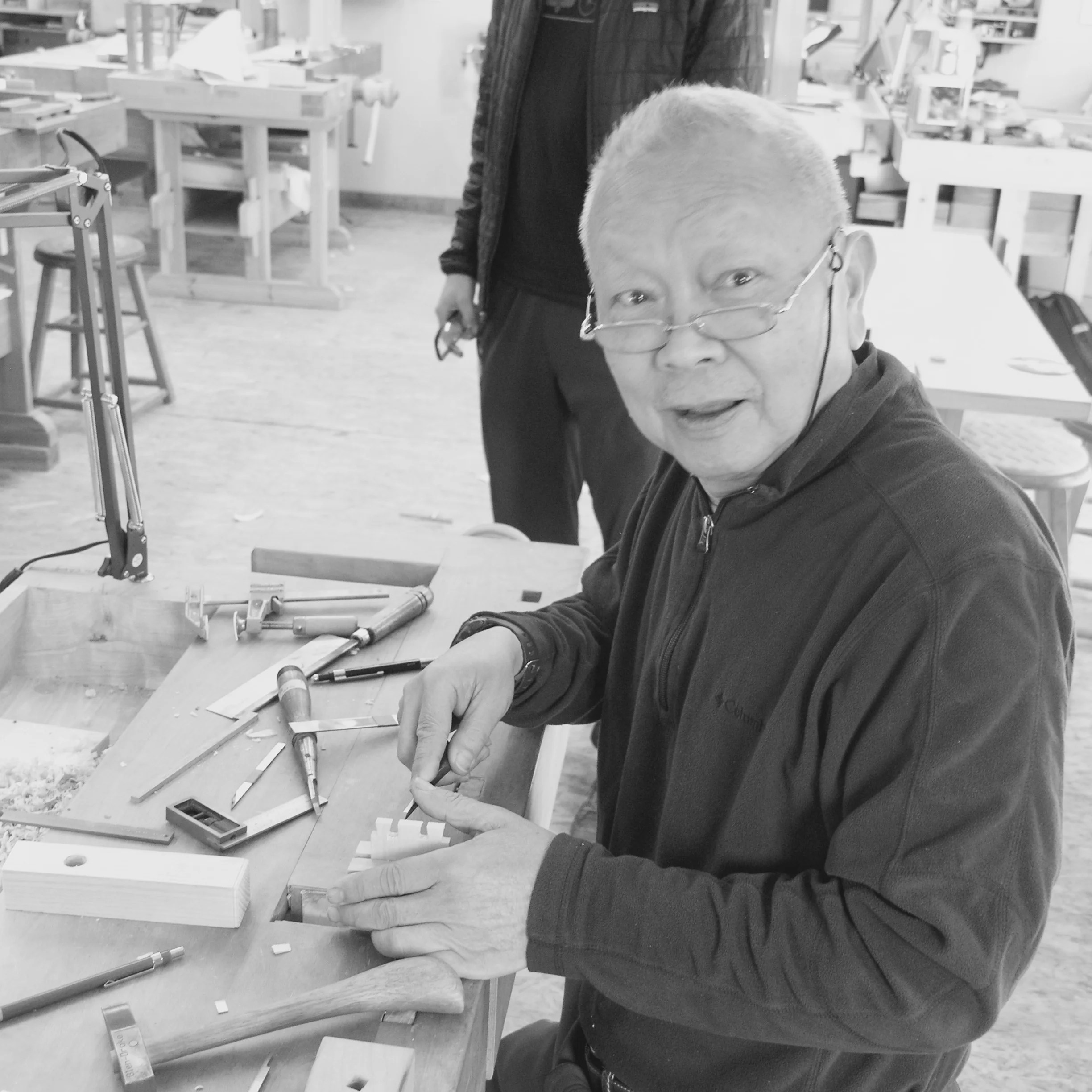
    At the end of summer term, we had a last minute cancellation. I’m not sure who we lost, but I am so happy we had the opportunity to work with Fu. He is a very patient man with a background in furniture manufacturing in his native Taiwan.

     Matt with his wabi sabi cabinet
    Matt with his wabi sabi cabinet

    Matt is a talented young craftsman who took full advantage of the 24/7 access to the school. In addition to completing all his exercises very well, Matt made a small dovetailed box in curly maple with a veneered sliding lid featuring parquetry, a very ambitious side project, beautifully done. We very much look forward to his return this spring for the Upward Spiral program.

     Greg working on bench top sawhorses
    Greg working on bench top sawhorses

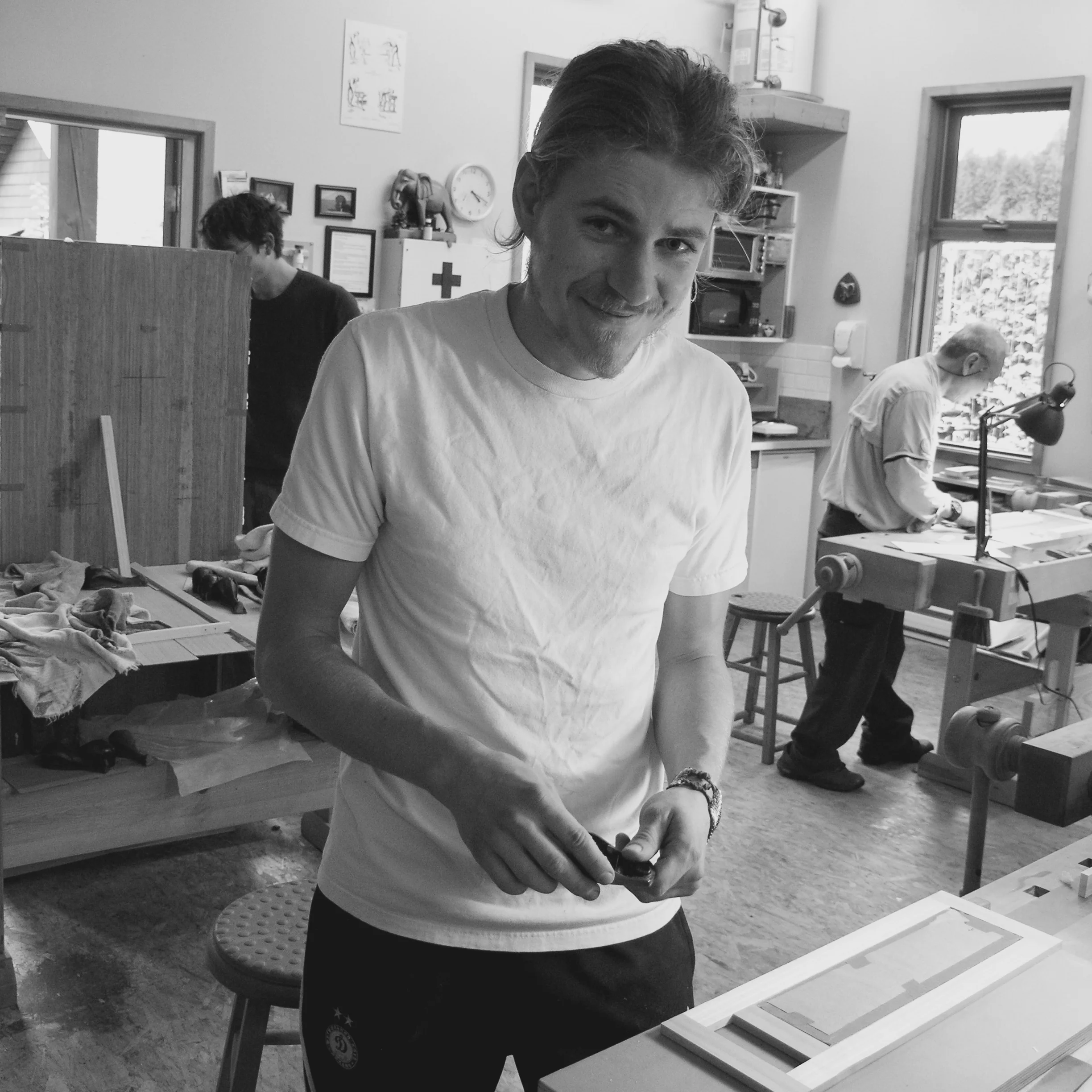
    Already a skilled woodworker, Greg used his time at the school to refine his hand skills and in doing so, did some of the tightest work we have seen in the Impractical Studies program. Greg’s passion for the craft was most evident in his work. Even having come from a machine heavy environment, Greg really embraced the emphasis on handwork here at the school. 

     Torrie planing surfaces
    Torrie planing surfaces

    Watching Torrie develop as a craftsman has been a joy for me. We are so grateful to have this fine young craftsman back for the Upward Spiral program next term, as he continues on his journey. Torrie shares his passion for the craft with his wife Maggie, who was regularly in attendance for the Saturday morning lectures and carries the other end of the plank.

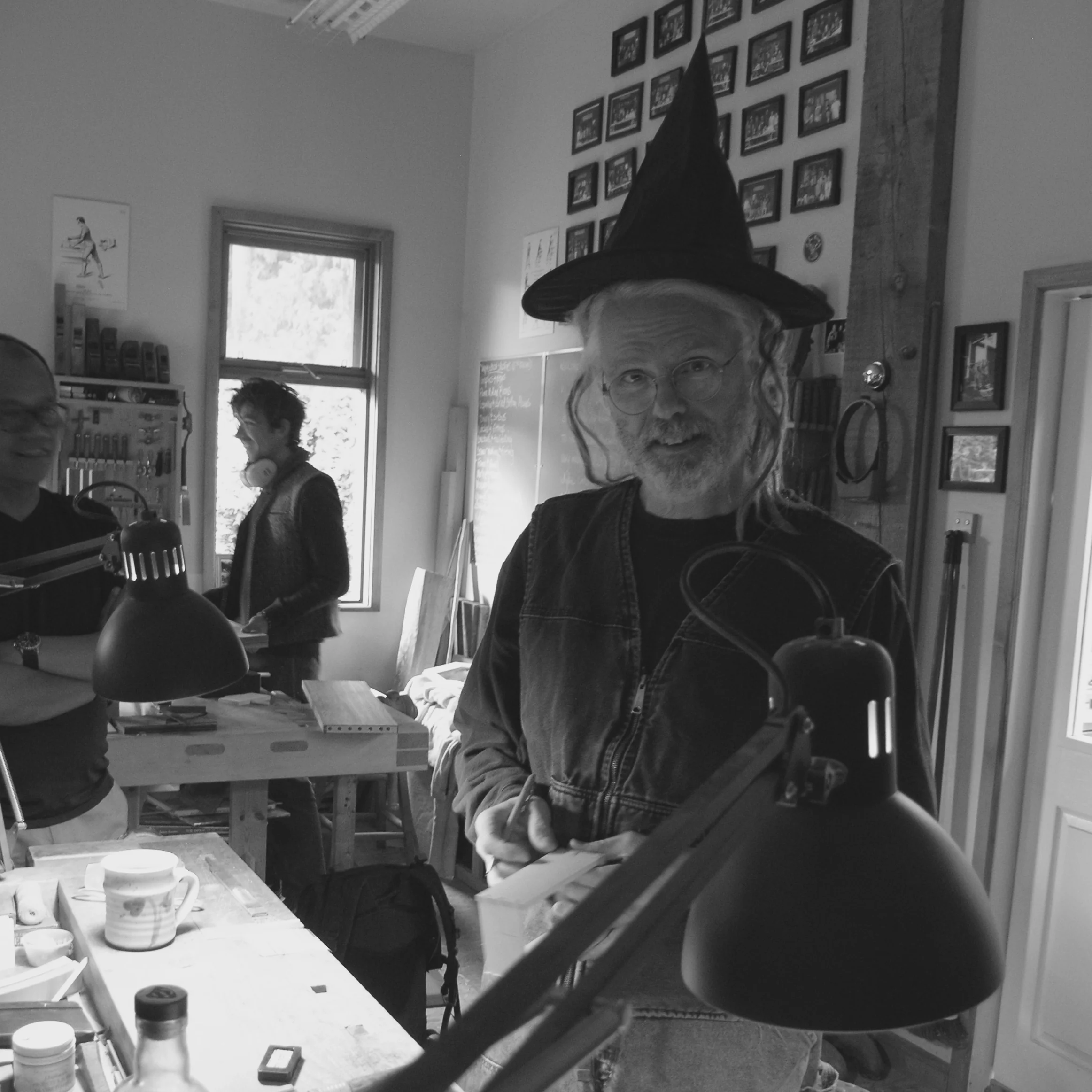
     the wizard hat of dark arts
    the wizard hat of dark arts

    The wizard hat was Yvonne’s suggestion for the dark arts lecture. I am including this image because I still love her, even though she often makes strange requests and suggestions.

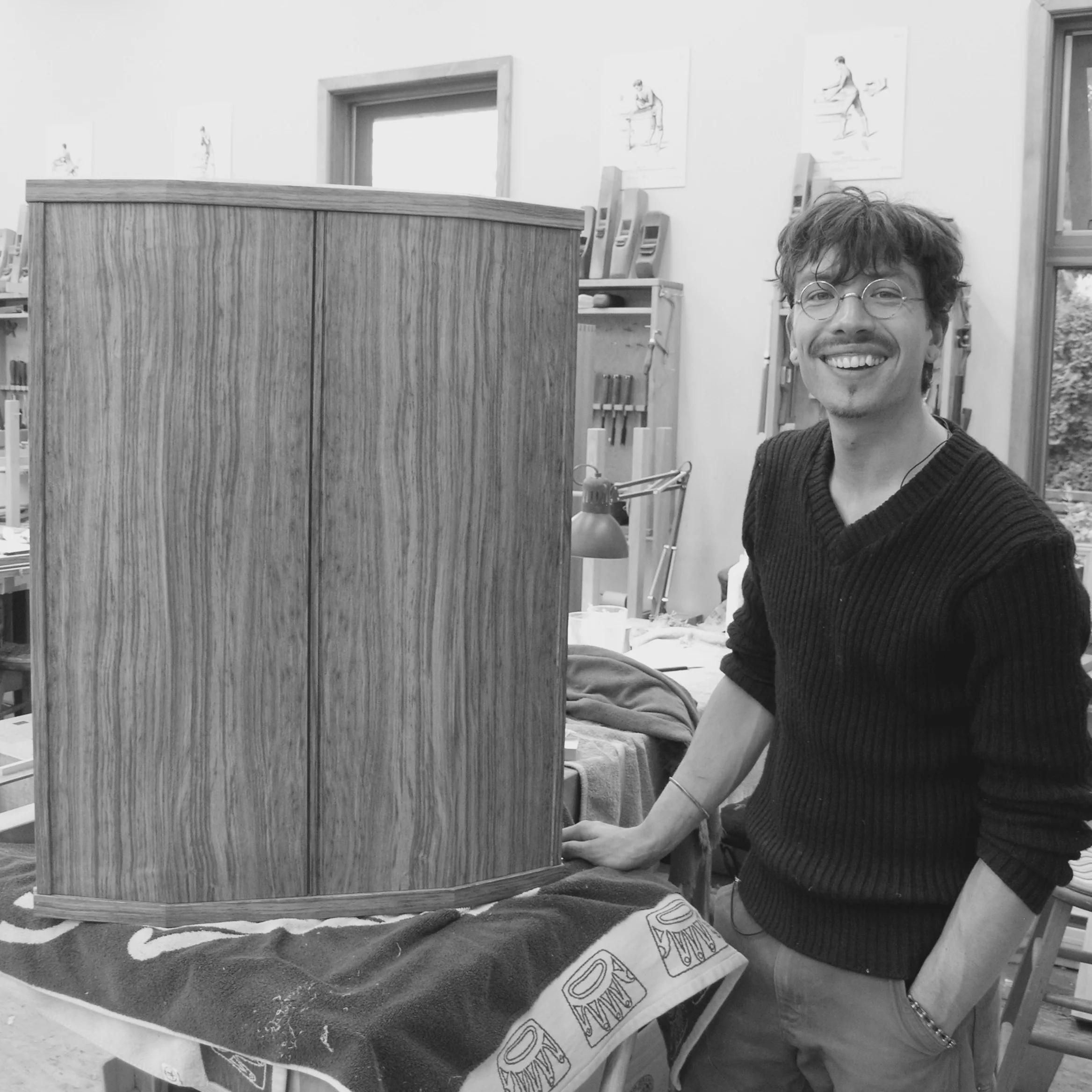
     Andre presents his fine cabinet
    Andre presents his fine cabinet

    Andre during the presentation of his upward spiral. Andre made a fine pipe cabinet out of a piece of garry oak, a piece that had been resting in my workshop for a few years. I bought the piece on a wood run to the Frazer valley with the pipe cabinet in mind. We are grateful to have Andre returning for the winter term for Vidar’s chair.

     lovely people, lovely work
    lovely people, lovely work

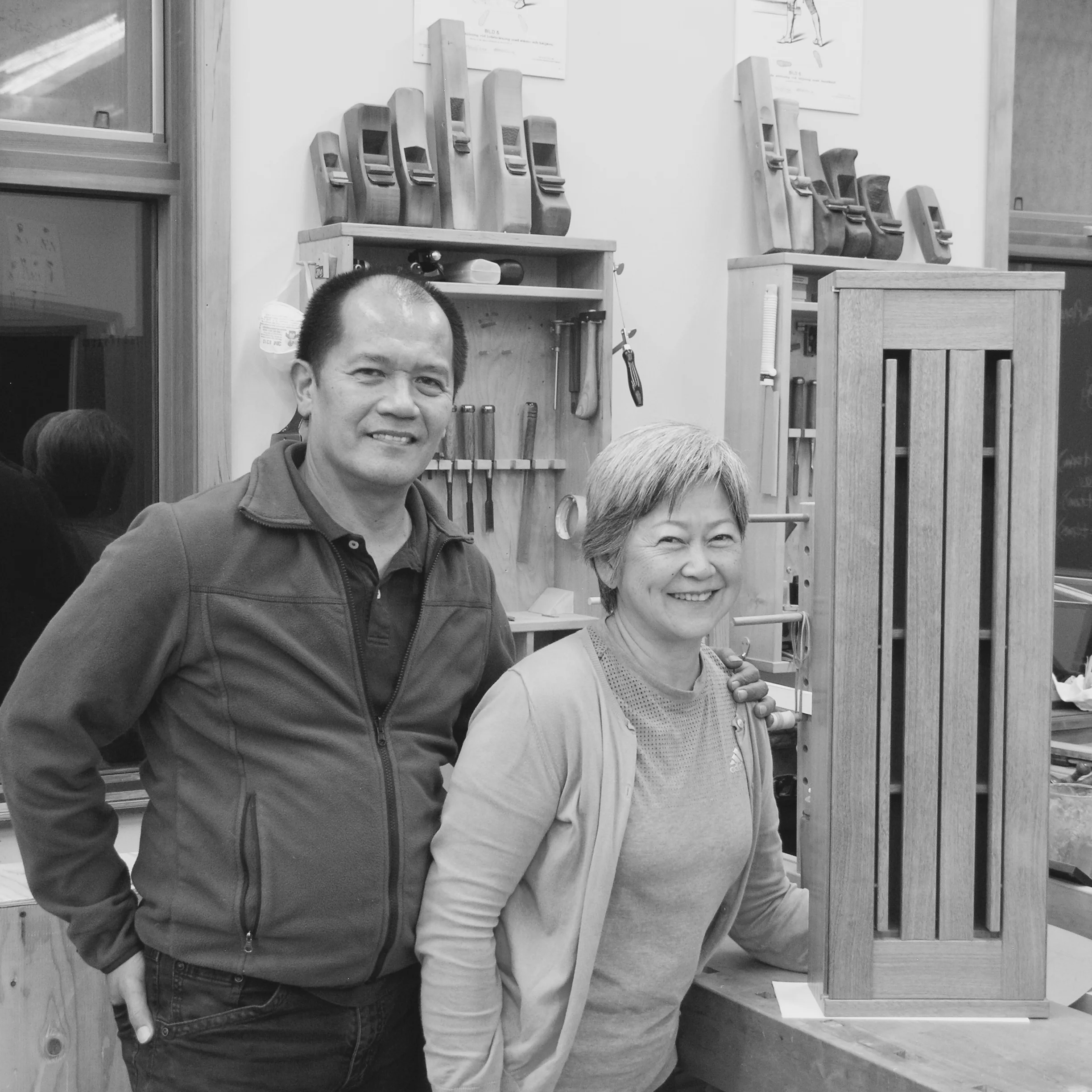
    Tang completed Impractical Studies last fall and went home, making several pieces before returning for the Upward Spiral program this past term. During the presentation of his fine pipe cabinet Tang shared with us his approach to the work; care, competence and confidence. While on the coast Tang’s wife Judy joined a local quilters group and was immediately embraced by the community.  We very much look forward to their next visit.

     sharing the work
    sharing the work

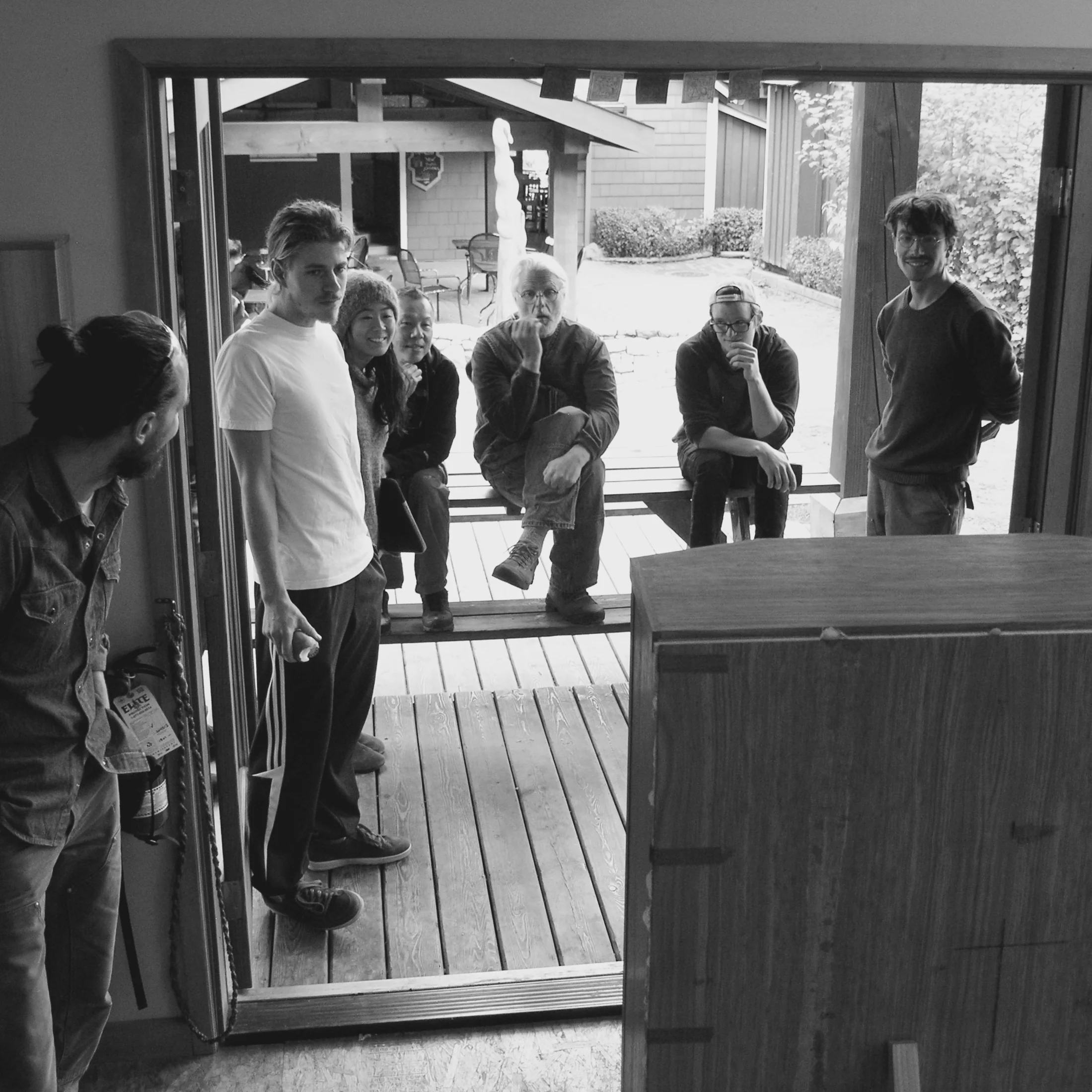
     Andi’s showcase cabinet is staged for the first time, a moment of celebration and impromptu walkaround. Sharing of the work with one another continues to be an important part of learning at the school. 

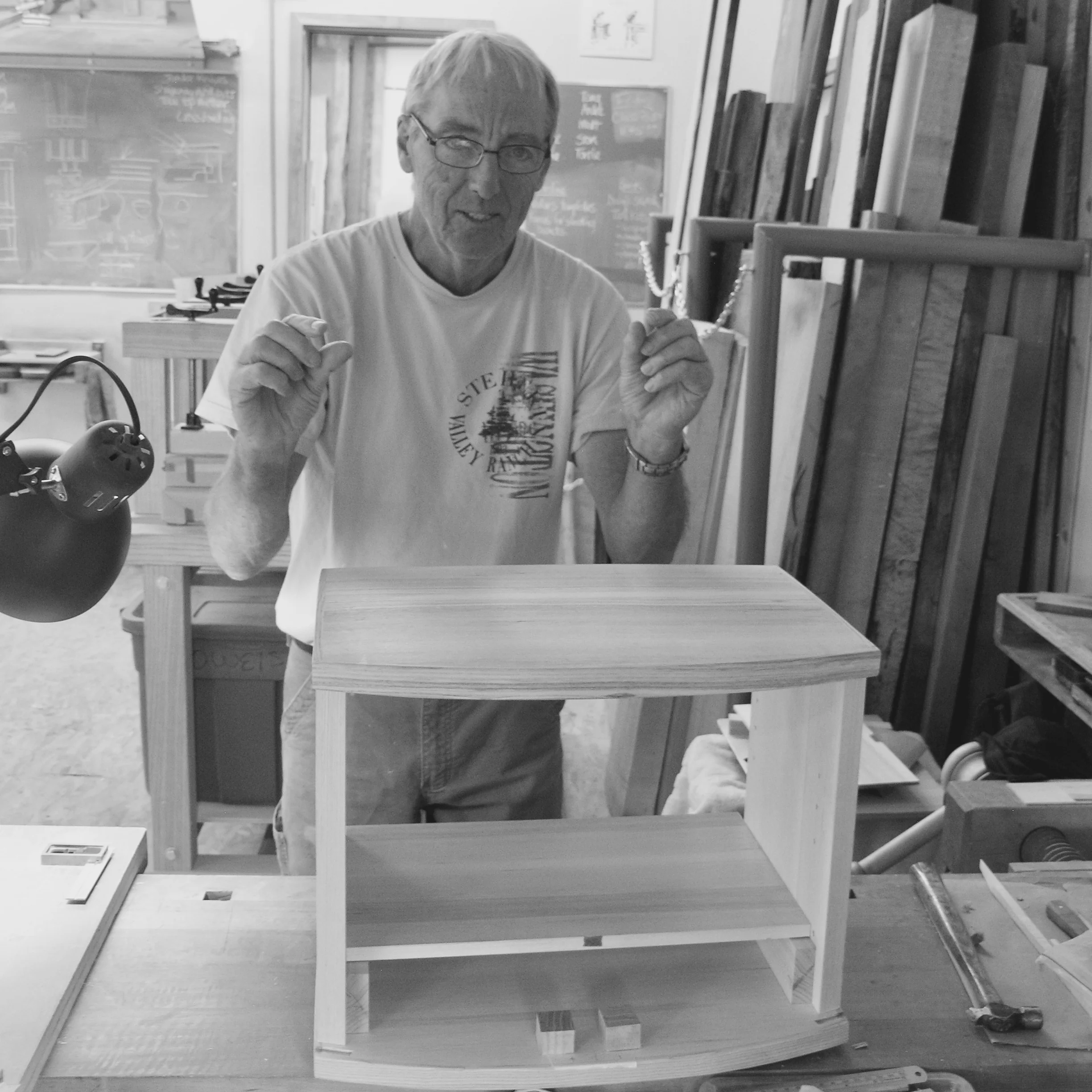
     Stan and fitting the horizontal partition of his cabinet
    Stan and fitting the horizontal partition of his cabinet

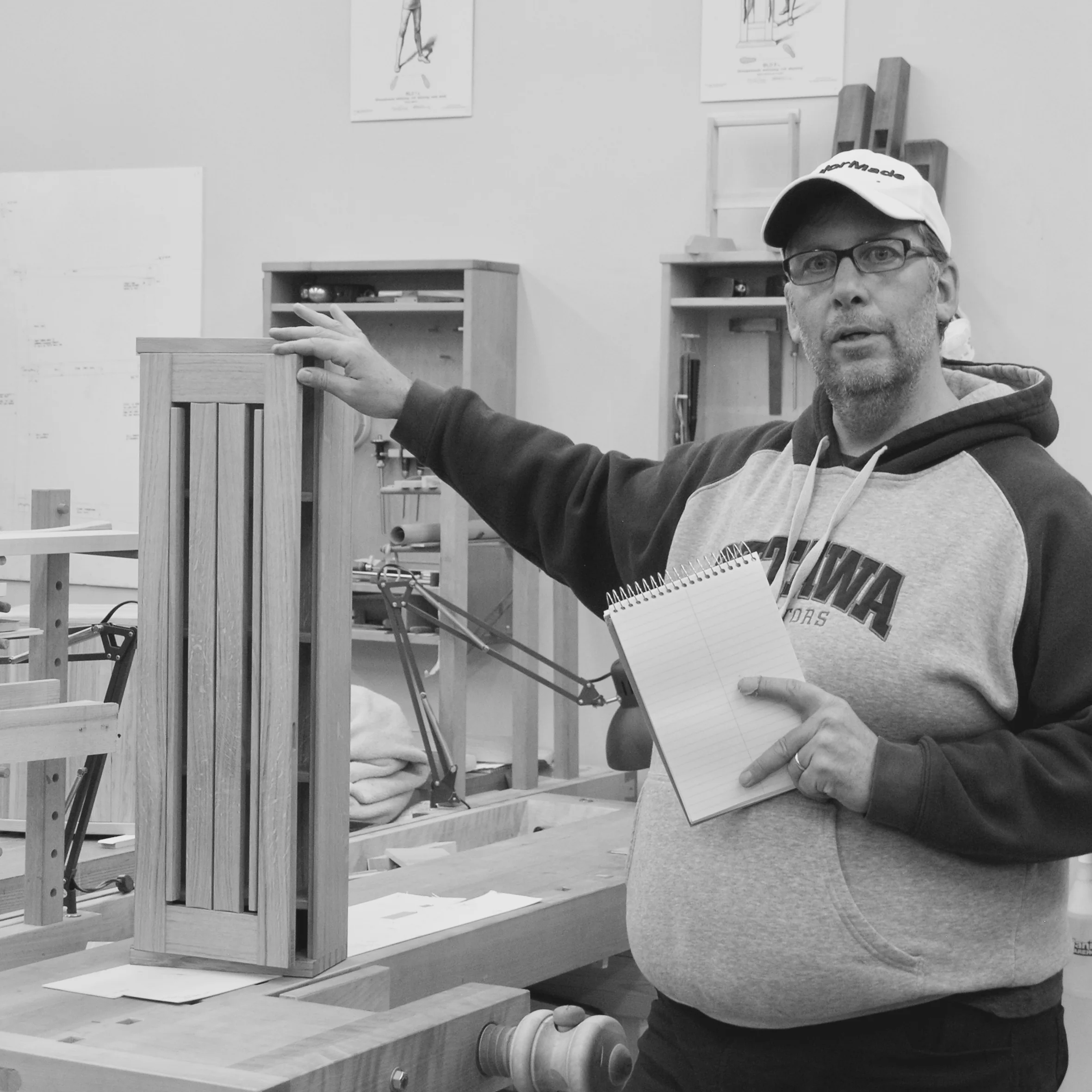
    This past term, was Stan’s sixth visit to the school. His first was during the last year Jim spoke at the school. Stan completed the Artisan program the rather condensed previous incarnation of Impractical Studies over a few summers while still working as an engineer. Within a few days of retirement, he returned for the Upward Spiral program where he made a fine cherry box and frame with a spalted maple panel. This past spring he joined us for Vidar’s chair. This term he began his composing program piece a fine double door curved front cabinet on a stand. The wood for the piece came from Goby’s on the wood run to Portland last fall. The tones in this piece of ash range from pinks, to orange to mauve unlike any ash I have seen before. With the wonderful colors came several defects that had to be carefully worked around. The intention was to make the case in solid wood, but once the doors where taken out the remaining wood a challenge to piece together. The decision was made to make lumber core and lay it up with shop sawn veneer and edges. There are many pieces of wood in this fine cabinet.

     Andi with doors hung on lower cabinet in English Brown Oak
    Andi with doors hung on lower cabinet in English Brown Oak

    Andi with the doors hung on his lower cabinet. The upper cabinet has since been completed with the glass doors hung and backs installed. Andi just has the pulls and base to complete next term before moving onto his next cabinet. Andi is the first recipient of the newly established Doug Ives Scholarship, which was announced at the celebration of life for Doug held at the school this past September. The intention of the scholarship, is to provide graduates of our Impractical Cabinetmaker program the opportunity to continue their studies at the school. Since the celebration of life we have received generous support for this scholarship through Doug’s family and our alumni. If you would like to make a donation to this scholarship, please contact Yvonne.

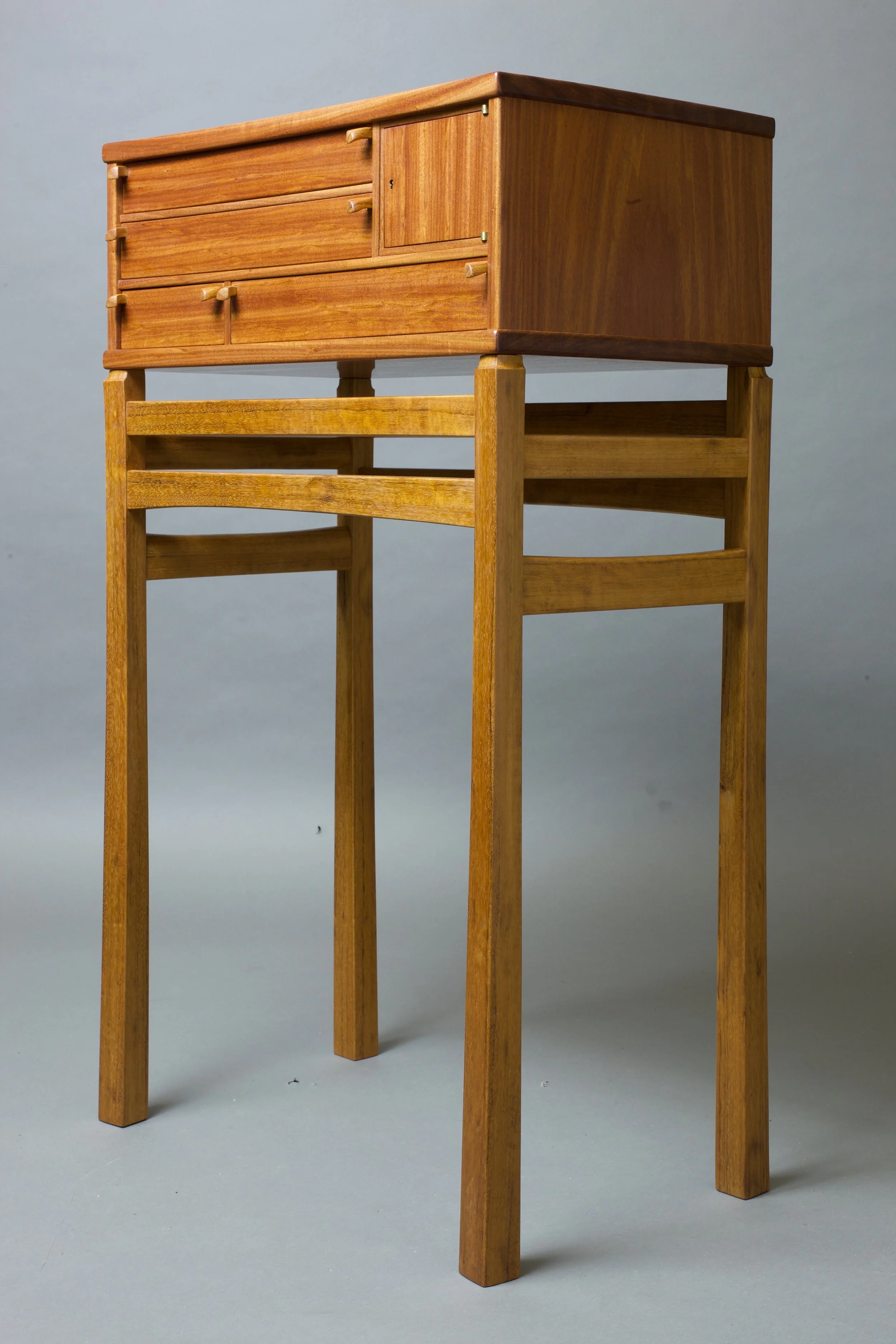
     'Heart' cabinet by Robert Van Norman  photography by Tim Andries
    ‘Heart’ cabinet by Robert Van Norman photography by Tim Andries

    This past term I completed a cabinet that I began thirteen years ago. I took the advice of Michael Burns, one of my teachers who suggested that after leaving school we build one piece a year from the heart. Since founding the school, I have found it a challenge to find the time and the focus required for such work. In the end there were three obstacles that stood in the way of completion of the cabinet. The damage to parts not carefully stored over the years, in many cases with no replacement wood. My abilities as a craftsman and the third the enthusiasm for the piece which wained over the years.

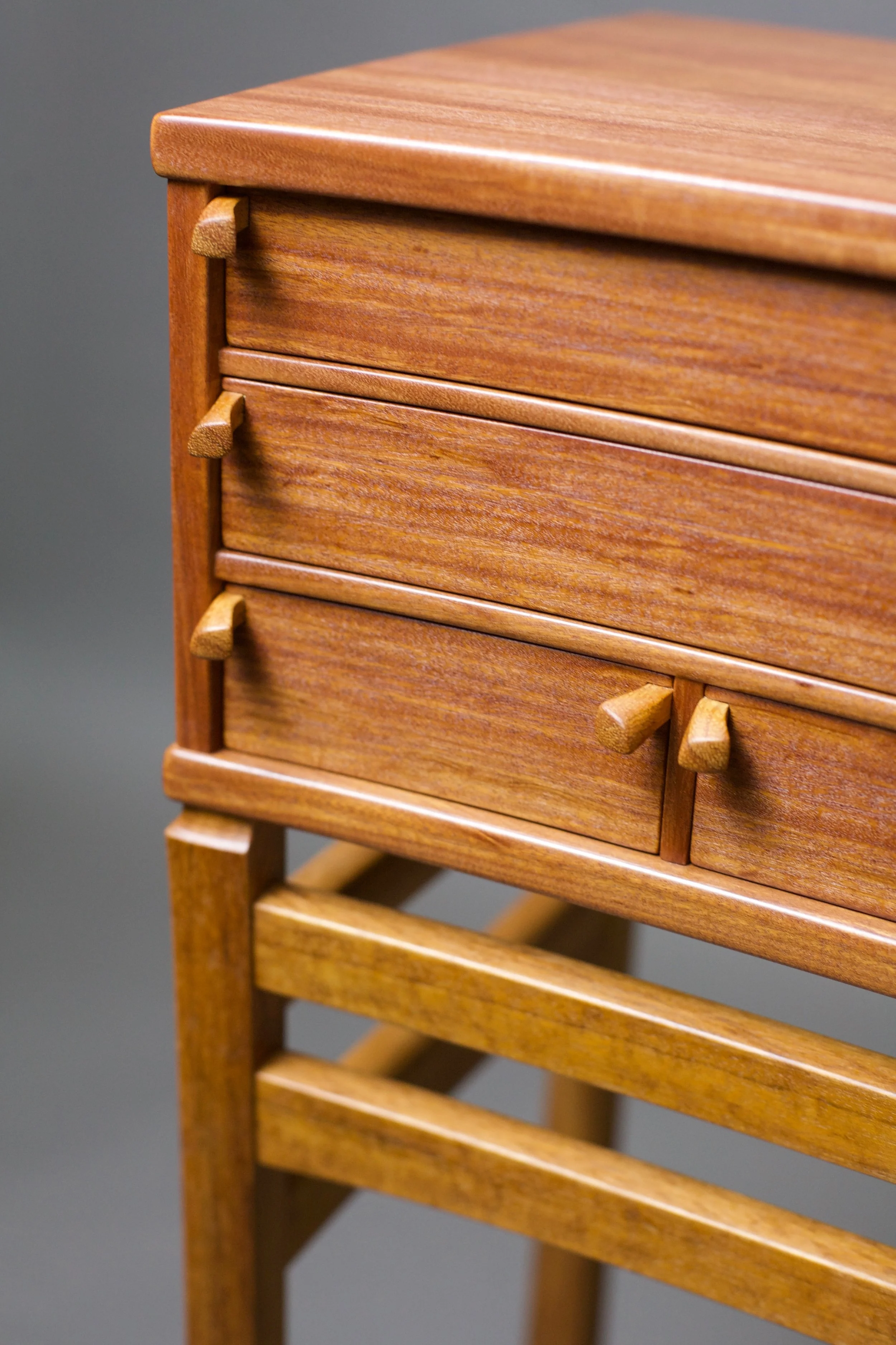
     pull detail 'Heart' cabinet by Robert Van Norman  photography by Tim Andries
    pull detail ‘Heart’ cabinet by Robert Van Norman photography by Tim Andries

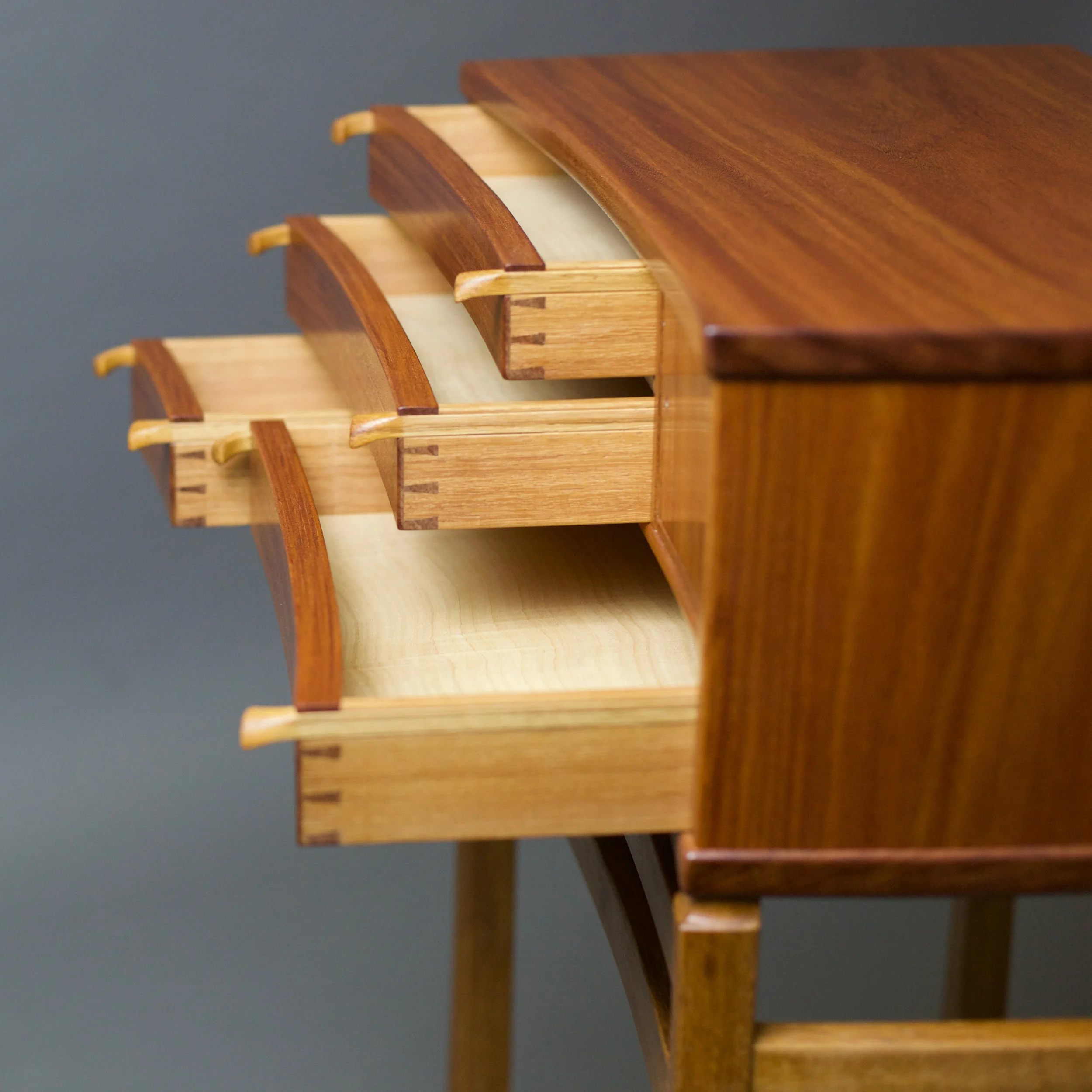
    As with most pieces I have made, this cabinet began with a piece of wood. In the dark corner of lumber yard in Burlington I found a small piece of Balsamo. I was immediately taken by the warm tones and the spicy floral fragrance which is still evident when one opens and closes the drawers. The balsamo was easy to work with a high angle plane. I have since past along to one of my students.

     drawer graphics detail 'Heart' cabinet by Robert Van Norman  photography by Tim Andries
    drawer graphics detail ‘Heart’ cabinet by Robert Van Norman photography by Tim Andries

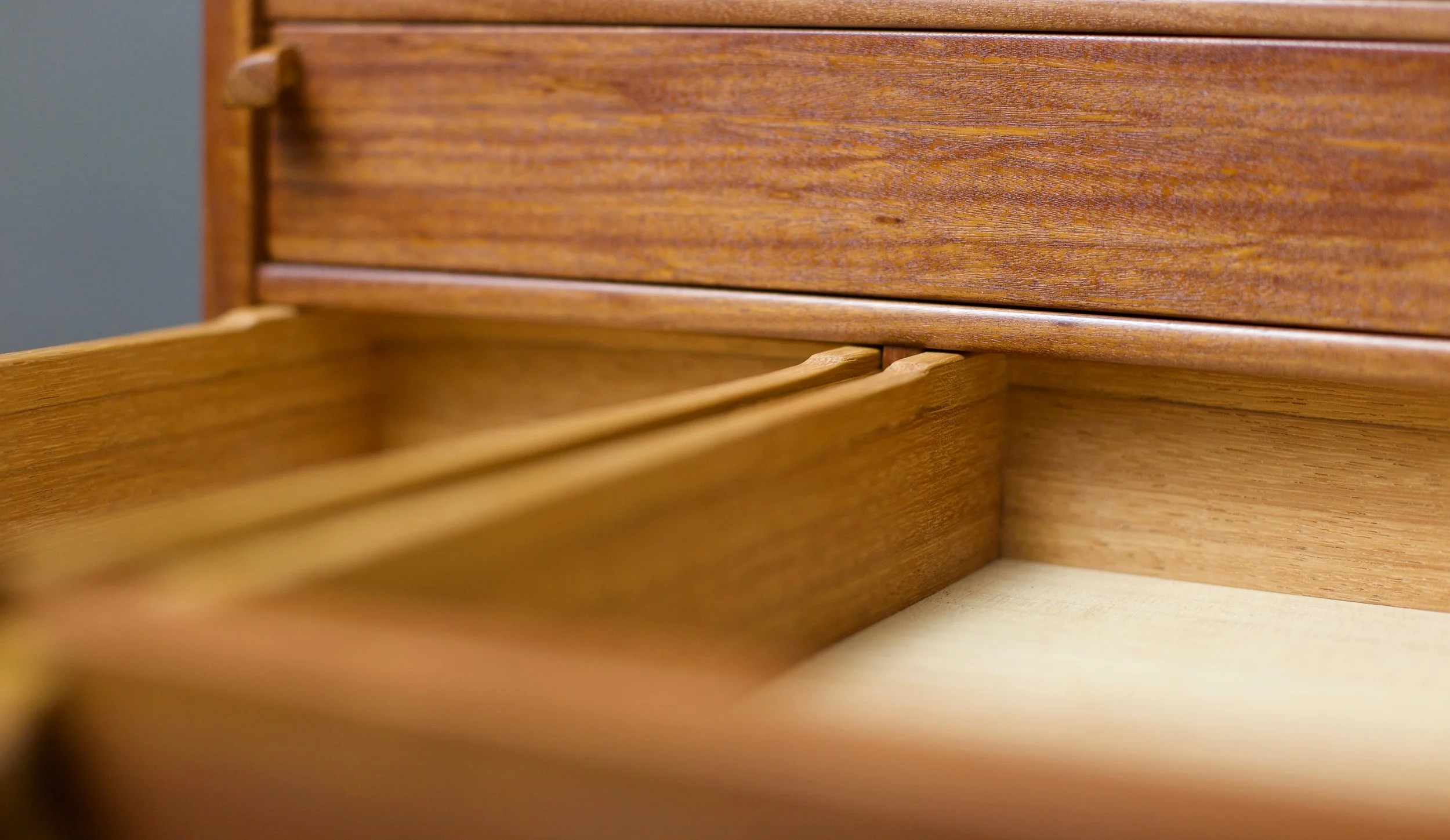
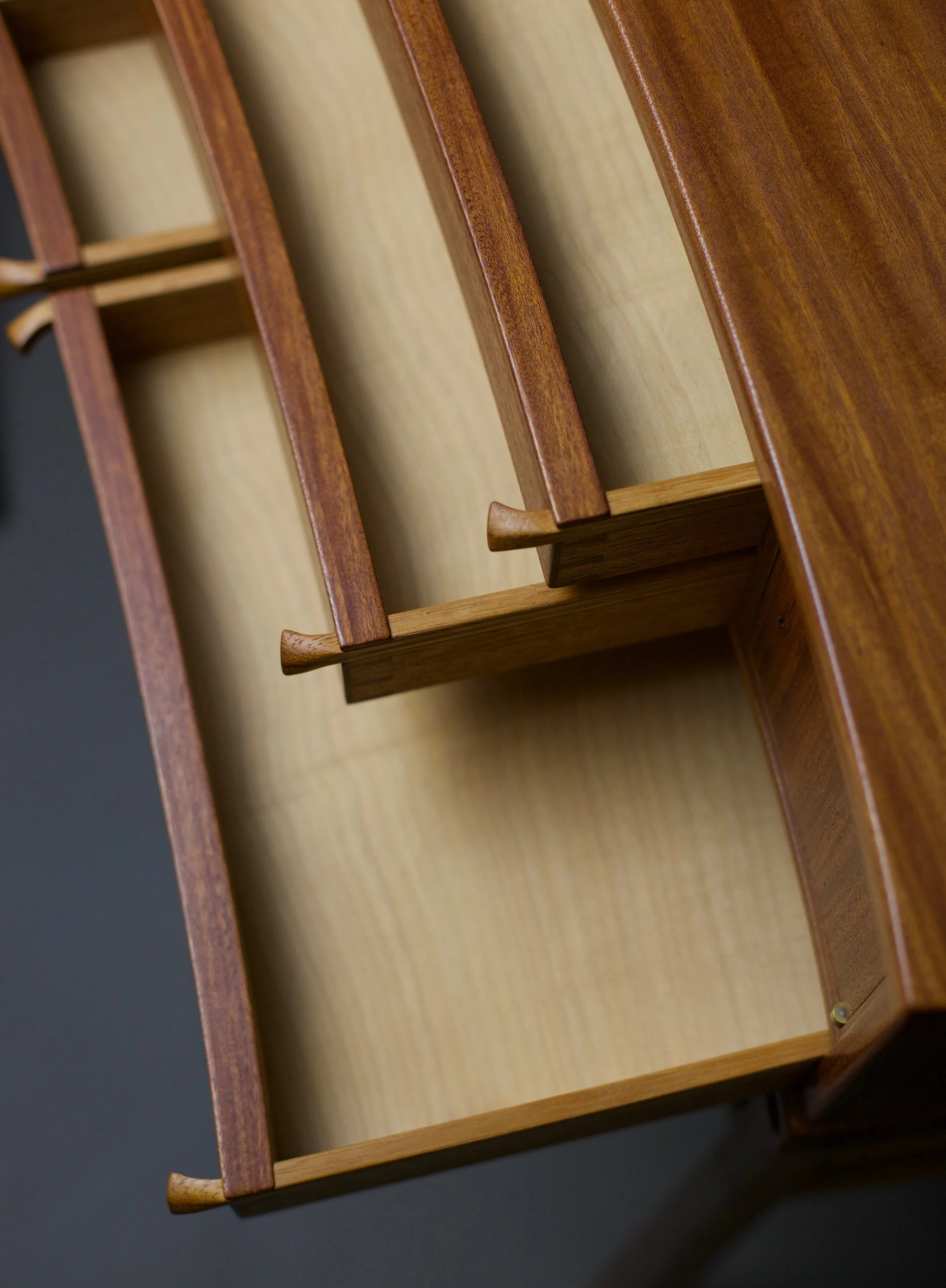
    The drawers parts were taken from a thick plank of doussie from Jim. The doussie was straight and rift, with a lovely dark streak that ran down one side of the plank which I aligned through all the drawers. The doussie was easily worked with my planes and spokeshaves. The pulls were a joy to curve with one of Jim’s fine knives.

     drawer bottom graphics detail 'Heart' cabinet by Robert Van Norman  photography by Tim Andries
    drawer bottom graphics detail ‘Heart’ cabinet by Robert Van Norman photography by Tim Andries

    The drawer bottoms are wonderfully fragrant Mendocino cypress with a bit of curl, a gift from Todd Sorenson (now teaching at the Krenov School) during his residency here back in 2007.


     stand detail 'Heart' cabinet by Robert Van Norman  photography by Tim Andries
    stand detail ‘Heart’ cabinet by Robert Van Norman photography by Tim Andries

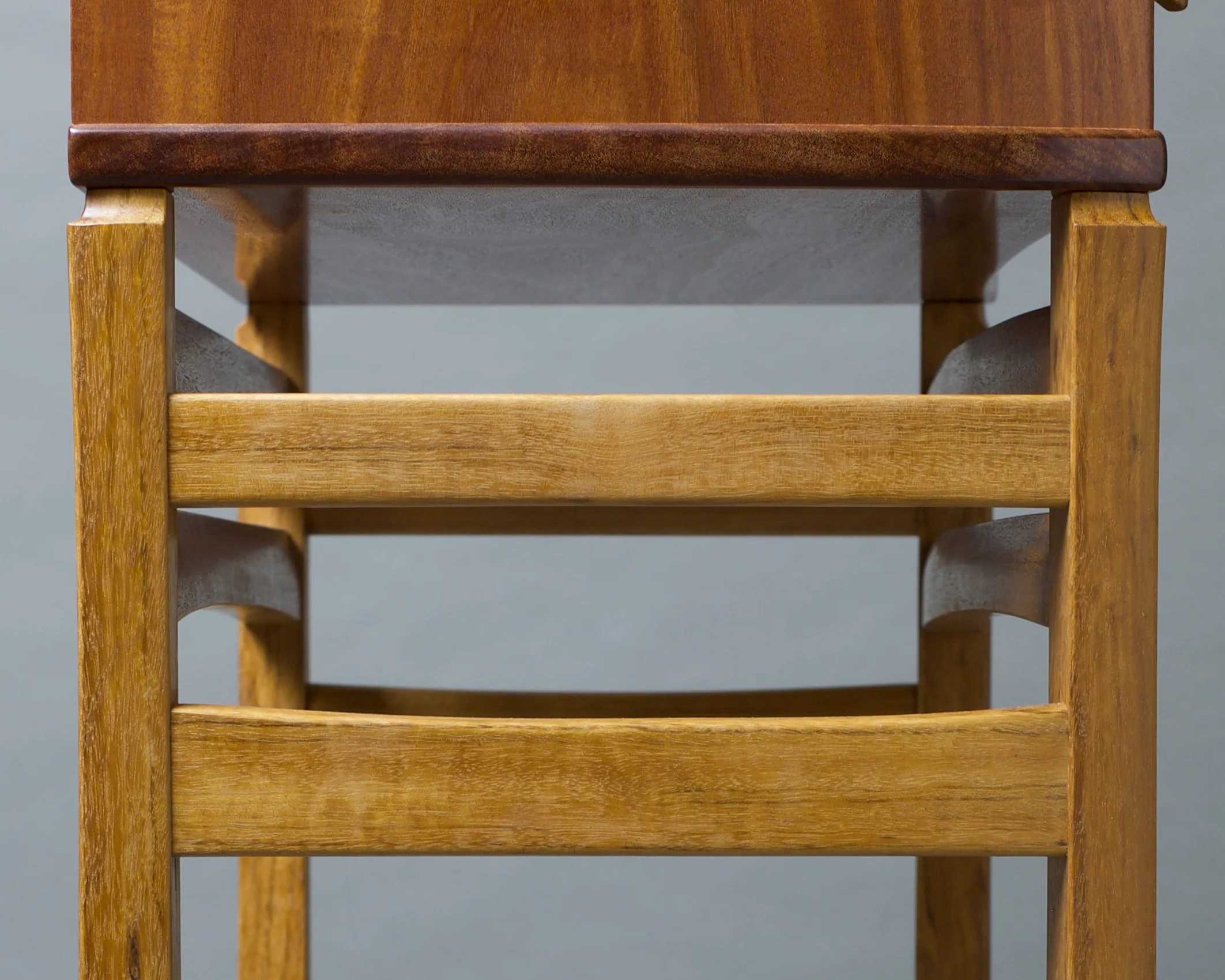
    The wood for the stand we picked up on a wood run on Vancouver Island a few years ago. I was looking for the right piece of yew to make the stand for my cabinet when Gavin, one of my students at the time said, “Would this be any good for making planes?” I said yes, that we had used goncolo alves for planes in the past, but that it would also work for my stand. Gavin was a kind and gentle soul and was very gracious allowing me to have that piece. I cut the shoulders and cheeks of the tenons on Jim’s bandsaw. The wood was very hard and had a lot of defects, but what was usable worked beautifully under Jim’s wonder shave.

     drawer detail 'Heart' cabinet by Robert Van Norman  photography by Tim Andries
    drawer detail ‘Heart’ cabinet by Robert Van Norman photography by Tim Andries

    I would like to take this opportunity to thank our students, our alumni and our families who make it possible for us to pursue this wonderful craft. I would like to thank alumni Tim Andries who has taken on the photography for the school. I will post student work from the last two terms when it is available. I would like to thank Caroline my co-teacher and dear friend who’s efforts enable me to return to the craft that so inspired me to found this school. And of course my partner in life and work, my soul mate Yvonne, who continues to keep it fun lovin’ and groovy.  
    Be well and enjoy your work,
    Robert

    ps Happy Birthday Jim:)

  • Fall 2017

    ADMISSIONS & STUDENT SERVICES

    Yvonne Van Norman

    RESIDENT CRAFTSMEN & TEACHERS

    Robert Van Norman
    Caroline Woon   

    RELIEF TEACHER

    Gary Kent

    COMPOSING

    Andreas Pfister – Germany
    Stan Adams – United States

    UPWARD SPIRAL

    Chung Leong Tang – Malaysia
    Andre Plante – Canada

    IMPRACTICAL STUDIES

    Torrie Smith – Canada
    Greg Hamilton – Canada
    Georg Maurer – Canada
    Fu Chang – Canada
    Matt Thornhill – Canada
    Henry Tsang – Canada