End of Summer Courses:
I would like to take this opportunity to thank our directors, teachers, staff and of course our students for all their support in making our first summer program such a success. We have made improvements to our Artisan Series for the summer of 2006. This includes three new one week classes, two six week sessions and one ten week session.
In a less than a week we start our nine month Craftsman Program which includes a full complement of students from Canada, the United States and Venezuela. Our first student/faculty show and open house will be held at our school & gallery in Roberts Creek on January 28, 2006. We have made arrangements for our year end show to take place at the Northwest Furniture Gallery in Seattle, Washington opening May 4, 2006.
We have already begun accepting registrations for next years Summer Programs and applications for the 2006-2007 nine-month Craftsman Program. We have recently received accreditation by Private Career Institution Training Agency in which our students will become eligible for Student Assistance and Loans for the Craftsman Program. For more information call Yvonne on our toll free number.
Week August 22: Design
We wound down our summer classes for 2005 with Artisan F: Design. In this class, students were introduced to the processes involved in designing furniture. Students were asked to arrive with an idea and a sketch for a small piece of furniture. They were given the opportunity to refine their sketch, make subsequent detail sketches and scale their sketch so that a mock up could be constructed consistent with their sketch.
Sketches often fail to give the maker or client an accurate interpretation of the object they desire to make. Therefore from the sketch students began a mock up that inevitably changes for aesthetic or functional reasons. An example is a chair that looks good on paper but when the sketch is scaled and a mock up created it ends up with a seat depth of thirty inches. After potentially days of mocking up and refinements made to the proportion, weight and form some of the subtle details may be worked out. The mock up is generally constructed of scrap material, including cardboard, and it can now be painted, grain and details drawn in, including exposed joinery.

At this point joinery decisions begin to be made. Templates are made and refined and the necessary forms made. Templates are used to make shop or working drawings, which are then made full scale to include joinery. Story sticks can be made from these drawings for efficient manufacturing. In this class students had the opportunity to work out and practice complicated joinery. This is a great primer for Artisan G Projects coming next summer to Inside Passage School of Fine Woodworking.
Week August 15: Introduction to Woodworking
In this course students were introduced to the possibilities of working wood with simple yet well-tuned and effective hand tools. We began the week with the harpening, tuning and setting up of the hand tools required. This included hand planes (including block, smoother and jointer), spokeshaves, chisels and scrapers.
After two days of preparation students were given the opportunity to effectively use these tools and learn the correct application for each tool. Students were then asked to flatten, prepare and burnish a face for finish on a piece of hard eastern maple sing a smoothing plane. Using a jointer plane, they then jointed the edge of the board square to the face and using the block plane students squared one end of board to the edge and face. Using these planes all the edges of the board were made friendly.
We then moved onto spokeshaves where Robert shared his first experience with spokeshaves. Erich Janish, a German trained master cabinetmaker was able to tune up and sharpen a spokeshave and use it to fit the edge piece of a veneered table with a few strokes after Robert, his apprentice at the time, had spent hours of frustration trying to achieve what Erich had done in a few minutes.

Applications were covered and the students were given the opportunity to tryout their sharpened and tuned spokeshaves on a piece of cherry. The first experience most people have with this tools is not a good one and it often ends up lost in the bottom of the tool cabinet. It is a pleasure to see the revival of such a fine tool.

This group, already experienced with machine tools decided to focus the week on hand tools so the last two days were spent starting a small dovetailed box of cherry. Robert demonstrated through dovetails. Students were asked to complete a few corners in poplar before moving onto the cherry. Students immediately discovered why cherry has long been a preferred wood by cabinetmakers. During this time the sharpening, tuning and applications and use scrapers were discussed and demonstrated.
As a craftsman and teacher I find it so rewarding to watch the progress of students. The first shavings from a tuned plane, joinery fitting well and shimmering planed surfaces.
On Friday afternoon Robert and the students visited the wood box and explored wood graphics and showed them how to acquire pleasing patterns that can make such a difference in a piece of furniture. For Max, one of our students from San Jose, California the light went on. He said that for that alone the trip was worth it. It is moments like this that make teaching worth it for me. We finished of a week of lovely weather with pints on the patio.
Week August 08: Tool Making and Curved Components
Tool making offers the maker an opportunity to make tools otherwise unavailable or tools that are specific to their work. So, on Monday morning we began the week, as we generally do, by preparing the hand tools required for the week’s class. Students prepared block planes, jointer and smoother planes, as well as card and cabinet scrapers, chisels, and spoke shaves. Students also took advantage of our evening hours throughout the week to continuously tune up their tools.
On Monday afternoon the students were introduced to simple metallurgy when they converted common files into paring and dovetail chisels. We began by heating the file to cherry red using a MPS* gas (common to the plumbing industry) and allowing it to gradually cool. This process softens the steel enabling the maker to shape and flatten the tool with grinders, metal belt and disc sanders, then eventually move onto sandpaper, diamond, and water stones.
 Once the shaping and flattening is complete, we reheat the tool to cherry red and quench it in peanut oil. This process hardens the metal, leaving it a bit brittle. The back is re-flattened and polished. The tool is then slowly heated at the nonworking end of the tool until it reaches near the cutting edge. It is then requenched in the peanut oil tempering the tool and making it more durable. Handles are then fashioned out of offcuts of sustainable exotic hardwoods.
 On Tuesday we moved onto double tapered laminations where students began with form-making. Students sketched the desired shape of a leg. Then a piece of 1/4″ MDF was band sawed in the shape of the leg. Spokeshaves, planes,files, and flexible sanding strips were used to fair and refine the curve. Each student then made a tapered-sled to thickness plane laminations to fit their individual form within a few .001″. The laminations were then pressed into the form using flexible cauls creating a tapered lamination which was then cleaned up with planes, spokeshaves, and a file.
 Later in the week, we moved onto curved veneered panels. Students began by drawing the top view of a curved door, making a template, and refining it as previously done with the tapered lamination form. A form was derived from this template and once constructed, three layers of Italian bending ply were laminated in the vacuum press in the form with a shop-sawn piece of veneer placed in as a spacer. Once dry the substrate was removed, baked in edges were applied then cleaned up. Students then carefully re-sawed a plank of western maple and removed the edges to be re-applied after veneering. Veneers of 3/32″, were cut, cleaned up with planes and scrapers, then applied using the vacuum press. Once out of the press, these edges are cleaned up and applied edges are shot with a hand plane before being applied on the curved veneered panel. Once complete the surfaces were hand-planed and edges made friendly.
Another wonderful week at Inside Passage was capped off with Elephants on the beach, with nearly two-dozen people in attendance! The occasion was even more special as it was also Yvonne’s birthday. There were many wonderful people who joined us, including Federico and his family who recently arrived from Venezuela. Federico, already an accomplished woodworker, will be one of ten students in our nine-month program, starting in September of 2005. This upcoming program will consist of men and woman from across Canada, the United States, and South America.
Student highlight: For this past week’s Tool Making class, we were joined by Cory Roberts from Hamilton, Ontario. Cory studied with Robert in 2003 and is considering attending the 2006 nine-month Craftsman program at Inside Passage School of Fine Cabinetmaking. Cory is a fine designer and craftsman who would like to take his work to the next level. He and his wife Sarah spent most of their evenings enjoying our beautiful part of the world.
Next week we move onto Artisan A: Introduction to Woodworking. Students will be introduced to the fundamental skills associated with Fine Cabinetmaking. Students will have the opportunity to sharpen and tune hand tools including: smoothing, jointer and block planes, spokeshaves, scrapers, chisels and scribes. Then the students will learn how to use them in a supportive and creative environment.
Week August 01: Veneers & Curves
This past week we ran our second Artisan E: Veneers & Curves, at Inside Passage School of Fine Cabinetmaking with a wonderful group of people from across the United States and Canada.
 We began the week, as we generally do, by preparing the hand tools required for the week. Students prepared block planes, jointer and smoother planes, as well as card and cabinet scrapers, chisels, and spoke shaves. Students took advantage of our evening hours throughout the week to tune up their tools.
 After lunch we moved onto shop-sawn veneers. Students carefully re-sawed a plank of maple, cutting veneers of 3/32″, cleaned them up with planes and scrapers and then applied those veneers—using both mechanical and vacuum press methods—to a baltic birch substrate fitted with baked-in poplar and maple edges. After applying edges to it, the panel was cleaned up using a block plane, smoothing planes, and a file. We burnished the surface with the smoothing plane shavings, leaving a surface ready for finish.
 With the veneered panel exercise nearing completion, we moved onto tapered laminations where students began with form making. A piece of poplar was band sawed into the shape of a small leg. Spokeshaves, planes, and files were then used to fair and refine the curve. Each student made a tapered sled to be passed through the planer, in order to achieve their individual form within a few .001″. The laminations were then pressed into the form, creating a tapered lamination, which was then cleaned up with planes, spokeshaves, and a file. Using a two-piece form forces the craftsman to work very accurately. The method that uses flexible cauls was also explained to simplify future work.
Thursday was spent finishing off the veneered panel and tapered lamination exercises .
Steam bending was introduced this week where a back splat for a chair was bent out of ash. Ironically enough, the only time Robert has used steam bending was to straighten out an applied edge for the top of a desk ten years ago!
 As James Krenov suggests after doing precise work it is often nice to just “make shavings”. So, we spent Friday making a small coopered door. Students began by refining their edge jointing skills and learning how to shift the staves so as not to disrupt the grain pattern. They then learned careful glue-up strategies, moved onto hand planing the concave and convex surfaces of the door, and then finally making all edges friendly.
Two of our students—Rich and Gary—have been through summer programs at the College of the Redwoods and wanted a refresher on how to sharpen and set up a coopering plane. The process was reviewed and all the students had the opportunity to set up one of Robert’s coopering planes.
Student highlight: Rich Gotz, one of our students for this week’s class had a project published in Fine Woodworking issue #169. Rich is a past president of the Minnesota Woodworkers Guild, a fine craftsman, and was a joy to teach.
Rich made the journey with a friend and fellow guild member Gary Wright also a true “Krenovian”. Gary took on a particularly difficult tapered lamination form and through shear determination found the fit.
Brent, one of our students this week who has studied with Robert previously, will be joining us for the inaugural nine-month Craftsman program beginning in September 2005. Brent has the makings of a very fine craftsman and we look forward to watching him develop over the next year.
Paul Keller, a professional woodworker from New Westminster, joined us this week in hopes of incorporating more curves in his work. Paul developed quite an appreciation for wooden hand planes while at the school.
Gary Kahne, a doctor from Salt Spring Island, is also avid woodworker whose tapered laminations where nearly perfect on his first attempt. Gary was a pleasure to have around and we look forward to his next visit.
A t our school we encourage students to develop a sensible balance between hand and machine tools. This last week, for Robert, it was the challenge to find the sensible balance between his own work, teaching, and the demands of running a school. Luckily, Robert is blessed with a fine support group at the school and in the surrounding community of Roberts Creek.
Next week we move onto Dovetails and Tool Making followed by Artisan A: Introduction to Woodworking and Artisan F: Design.
The count down is on: less than one month until the start of our nine-month Craftsman Program!
Week July 25: Making Hardware
 A fine craftsman, an inspiring teacher, and a dear friend—Michael Burns—joined us for Making Hardware this week at Inside Passage School of Fine Cabinetmaking. Michael was accompanied by his wife Julie, a warm and gentle spirit who is capable of brightening anyone’s day.
Students began the week making wooden pulls. Michael showed a slide presentation and brought samples which generated ideas for the students and demonstrated the processes involved in making some of these pulls.
 Each student began with a sketch, made a mock-up, then refined the mock-up, before moving onto making a pull (complete with joinery) of precious wood provided. Wooden pulls are typically done in pairs, making them easier to handle. Shaping and cutting the joinery for two provides matched end-grain on the finished pull. Walk-arounds were done on a regular basis throughout the week to ensure students were given a broader perspective of the work being done by their peers in the class.
On the second day students were introduced to making “Krenovian” latches and pressure buttons. These simple wooden latches provide the maker means of stopping doors and holding them in place. The sound of wood on wood is very pleasant and these latches are relatively simple to adjust.
 In the afternoon of the second day, students moved onto working with brass and performed an exercise in cutting, squaring, and shaping brass using simple tools. Michael began to demonstrate some of the many patinas available – including using cupric nitrate, shavings and heat, and combinations thereof. Patination was taught on an ongoing basis, giving the students ample opportunity to experiment with many of the patinas available.
Students were given evening hours from Monday to Thursday until 9pm. They used the time to sharpen tools and work on sketches.The relaxed evening hours saw more than just hand tools—Michael Mulrooney and Pat played a few tunes together on the banjo and mandolin.
 On Wednesday, Michael began by talking about applications and the appropriate sizes of knife hinges. Students learned about the processes involved—including drilling for pins, reaming holes, countersinking for screws, and shaping. Students each had the opportunity to make several pairs of straight hinges while Michael went on to teach the applications and the process of making offset L hinges.
Bob Sanderson, one of Robert’s classmates from the College of the Redwoods Fine Woodworking Program, and his wife Taimi, also a CR grad, came by the school for a visit. They brought along a stock of hinges, hangers, and sliding bolts which we now stock at the school.
 Bob gave a talk about his goals of improving on commercially available hinges including making the installation easier and improving the fit and finish. Bob also demonstrated the making of ring pulls. He has a sound knowledge of the subject, is a fine craftsman, and has a clear and gentle way of presenting his ideas and thoughts. We hope to see more of him in the future at Inside Passage. For more information about Sanderson hardware, including custom work please contact the school directly.
 On Wednesday evening, we were joined by students, former students, former classmates, teachers, family, and friends as Michael spoke and presented a slide show which documented his work and the work of his students, with an emphasis on hardware. There was a full house at the Gumboot Café followed by an open house at the school were our newest addition to the gallery—a coopered lid, dovetailed box of Myrtle by Michael Burns, including hardware of brass, and silk lid stays woven by a colleague of Michael’s from the college – was shown. In attendance were seven College of the Redwoods alumni including Larry Stroud, a lovely man and fine craftsman from Sebastopol, California who also took Michael’s class.
 On Thursday, Michael moved onto the making of drop pulls of brass and wood. He brought with him several samples of his own work, as well as those made by Greg Smith, currently a teacher at CR, and Jay T. Scott, a graduate of the CR program. Students then went through the processes of designing and making his/her own drop pull.
Throughout the week, we were treated to mandolin music by Pat, one of our students from Corvallis, Oregon. Pat was generous enough to share his love of music with Robert, who even managed to learn a couple of cords.
The weather for the week was flawless in Roberts Creek. Our guests were treated to sunsets and dinners on the beach. On Friday, as is tradition, Elephants was held—this time in Michael and Julie Burns’ honor. Family and friends gathered to enjoy salads,fresh local salmon, and corn grilled on the fire pit. It was a lovely evening capping off a wonderful week.
Robert continued to work on his cabinet. He made a door, selected, milled, and prepared the surfaces of the Mendocino Cypress and Red Cabruva to be used to line the door compartment. Robert has hinges to make and a lock and key to modify, both of which will receive a patina before installation. Michael’s insights in these areas the past week were invaluable.
Next week we move onto Artisan E: Veneers and Curves. Students will be guided through the processes involved in veneering, tapered laminations, and coopering. Until next time, continue to enjoy the many subtleties of our craft!
Week July 14: Joinery
 The inaugural Artisan D: Joinery class was held this week at Inside Passage where students were introduced to joinery used in fine furniture making. As usual, we began the week sharpening and tuning the hand tools required for surface and edge preparation and the final fitting of joinery. In addition to their block planes, chisels, and scribes, students were provided with wooden smoother and jointer planes made at the school which were then tuned by the students themselves, while they took advantage of evening hours throughout the week.
 With the necessary preparation work behind us, students were introduced to a simple yet effective low-tech doweling method using the drill press, horizontal boring machine, and/ or a hand drill. Students were given the opportunity to use these new-found methods to complete a small wall cabinet. The cabinet, done in poplar, was prepared with the same considerations and care used in making fine furniture. Each component of the cabinet was hand-planed and the edges softened to a friendly “happy” state. Students were introduced to the concept of let-go, making the cabinet slightly tapered from front to back. This allows the maker to fit a drawer that runs true and—just before leaving the cabinet—the drawer tightens, preventing it from falling out of the cabinet and onto the ground.
 With the cabinet doweled, students planed the back of the cabinet flush and routed a rabbit to accept a frame and panel back. The cabinet was then carefully assembled in three stages: A frame and panel was made with considerations for seasonal movement and grain orientation; open mortise and tenon joinery was used on a fitted panel with a hidden pin (allowing the panel to come and go with seasonal humidity); and finally the frame and panel surfaces, and the edges were prepared for finish and carefully assembled.
 Next we covered variations of the mortise and tenon joints—such joints as live, floating, compound, multiple, and wedged tenons. These joints were executed using a router and slot mortiser. Next we moved onto the careful fitting of the frame and panel into the back of the students’ cabinets.
Students of varying skill levels each walked away with a lovely little doweled cabinet with a frame and panel back, razor sharp tools, the understanding of a sensible balance between hand and machine tools, and the knowledge of how to make a variety of mortise and tenon joints.


Student highlight: Throughout the week we were treated to wonderful hand made pies by Don, one of our students who operates a woodworking business in Whistler; the families of our students were treated to exceptional weather; and the partner of one of our students took advantage of our creative and inspiring area and spent the week painting in preparation for her upcoming show.
Updated Summer Schedules, Resident Bench Craftsmen arrive
We have updated our Summer Program schedule for 2005, see the new schedule under the Programs section. Our Summer Program Schedule for 2006 is also now available and it includes a completely revised Artisan Series including a 6-week Artisan Program and a 10-week Artisan Program and Projects Course. New for 2006 is the 4-week Artisan G -Projects course where students undertake a project under the consultation of Inside Passage faculty.
Our first two Resident Bench Craftsmen, Peter and Cody, have joined Inside Passage. For more on these craftsmen see the Resident Bench section under “Programs”.
Week July 04: Marquetry
 We finished another week of classes at Inside Passage School of Fine Cabinetmaking. This week we were pleased to host Julie Godfrey from Massachusetts. Julie studied under modern masters James Krenov and Silas Kopf and was a classmate of Robert’s at the College of the Redwoods. It was especially nice for their families to have the opportunity to reconnect.


Marquetry is very focused, often intense and intricate, work. Julie provided the class with time to relax by giving several demonstrations and daily slideshows which included the history of Marquetry, sequence of processes covered, as well as the work of the world renowned marquetry craftsman Silas Kopf, with whom she apprenticed.
Students began the week choosing a somewhat simple (this of course, depends on your perception of simple!) image which they then traced and transferred onto the veneer. This was followed by a more intricate project: Julie demonstrated shading using fine sand (in this case from just down the road) in a cast iron skillet on a hot plate. Edgesof the veneer are set in the sand for varying lengths of time creating shadow lines or shading. Using the bevel-cut method, subsequent veneers are added until a picture appears. Students used fret saws and birds mouth fixtures made here at the school. The picture is then inset into a background veneer. With this process complete, Julie demonstrated the process of vacuum pressing.
 A group project was started using the Boulle method, where brass and typically rosewood or ebony is used to create a negative of one another. The scroll saw was used for this process. And Julie emphasized throughout, that organization is the key since there are so many little pieces of wood and brass.
Julie also gave a talk and demonstration on three-dimensional drawing. Julie’s abilities as a marquetry artist are only enhanced by her wonderful sketching ability. Julie also demonstrated the process of repetitive packet cutting. Graciously, she used the hide glue out on the deck.
Although commercial veneers were used for the class, primarily to increase the palette available to students, Julie demonstrated the process of re-sawing veneers giving the students the ability to prepare their own veneers.
 On Thursday evening Julie presented a slide show and spoke a little on the history of Marquetry, from its early forms on up to the modern masters –including the work of Silas Kopf and her own. We had a wonderful turnout for the show including Brad Bielka, another classmate of Robert and Julie’s from Santa Cruz, and his partner Lisa. The open house that followed proved to be an excellent opportunity for students to show and talk about their work, and for the community of Roberts Creek to have a closer look at what our school is all about.
A wealth of information presented by a fine teacher. We will look forward to her next visit.
Week June 20 : Chair Making
We just finished two very informative and entertaining weeks of classes here at Inside Passage School of Fine Woodworking. Ejler Hjorth-Westh, currently a teacher at the College of the Redwoods Fine Woodworking Program in Fort Bragg, California, joined us for a two-week chair making class. Ejler began with the history of chair design, moving on to the functional and practical elements of design, and then Ejler spoke about sketching and preparing full-sized working drawings.
In January, Ejler and Todd Sorenson, Ejler’s current apprentice, presented our school with a set of “ducks” used in traditional boat building to lay out curves. Ejler demonstrated with these amazing little tools and inspired the students to collectively make a set that was raffled off later in the week. Cody Bradford, one of two of our resident bench craftsman, was the fortunate winner.
 From their working drawings, students made templates of the legs which they then faired and refined, and later used to create full-sized models (or mockups) of their chairs. The mockups were made of poplar and screwed together so that they could be disassembled quickly to make refinements. This process can typically last several days.
Ejler then discussed joinery used in chair construction, including compound angled floating mortise and tenon. In addition, he demonstrated a sliding dovetail which he uses to join the arm rest with the rear leg and seat rails. Much of this joint is done by hand and allows the craftsman to make adjustments with a few strokes of a hand plane. Robert demonstrated another method for compound angled joinery using twin live tenons.


On the first Friday, Karen and Ejler hosted Elephants. This tradition started at the College of the Redwoods back in the early eighties where students (current and past), teachers, and friends gather for food and drink—developing a strong sense of community. Karen, Ejler’s wife who operates a fine catering business in Mendocino, treated us all to a few of her fabulous dishes!

Chairs are typically built in multiples. For this reason, Ejler started the
week off by demonstrating a number of simple, yet very effective, jigs and fixtures used in the millwork process of chair making, including shaper work.
Ejler introduced the group to two means of bending wood: Steam bending, a method which he employs for curving the back splats of many of his chairs; and bent laminations using forms and flexible cauls. Robert also shared with the group the use of tapered laminations, which he uses often in his own work.
 After several years of frustration involved in finding an upholsterer to do fine work, Ejler approached an upholsterer who was willing to give him a crash-course, providing he would not bother him again. Ejler has certainly refined the process since then. He showed the group the upholstering—including the seat frame, webbing, use of Dacron and foam, covering, and finishing. The end result was a seat that was comfortable and looked great!
 On Thursday, Ejler presented a slide show and gave a talk, which was followed up by an open house at the school. We had guests from both eastern Canada and the United States in attendance.
Ejler finished off the week talking about finishing. He prepared an oil finish that he used to refinish his chair on display in our gallery, which has seen a lot of use since our opening.
 In the end, there were nine refined mockups and nine very happy students. Elephants was held in Ejler and Karen’s honor, where we were joined by family, friends, and former and future students of Inside Passage School of Fine Cabinetmaking.
Week June 13: Dovetails & Tool Making
Another busy and enjoyable class has finished at Inside Passage School of Fine Cabinetmaking. This week’s students were invited to look at the intimate relationship which exists between the tools, the materials, and the maker. Students began the week preparing their tools for cutting dovetails, including block planes, smoothing planes, chisels, scribes, and violin knives. Students learned the processes involved in the sharpening and tuning of these instruments to be used later in the week. To break the monotony of flattening irons, students completed a shooting board and chopping block also to be used later in the week.
 On Tuesday the students were introduced to simple metallurgy when they converted common files into paring and dovetail chisels. We began by heating the file to cherry red using a MPS* gas (common to the plumbing industry) and allowing it to gradually cool. This process softens the steel enabling the maker to shape and flatten the tool with grinders, metal belt and disc sanders, then eventually move onto sandpaper, diamond, and water stones. Once the shaping and flattening is complete we reheat the tool to cherry red and quench it in peanut oil. This process hardens the metal but leaves it a bit brittle.
 The back is then re-flattened and polished by the student. The tool is then slowly heated at the non-working end of the tool until it reaches a straw-like color near the cutting edge. It is then re-quenched in the peanut oil, tempering the tool and making it more durable. Handles are then fashioned out of off-cuts of sustainable exotic hardwoods.
 After two days of metalworking, we were ready to put all of the preparation to use and start cutting dovetails. We began with a demonstration of cutting the pins and were joined by Gary Kent, a College of the Redwoods graduate, who will be teaching with Robert during the Craftsman Program this fall.
Students had an opportunity to practice cutting the pins before Robert demonstrated the cutting of the tails and transfer process later that morning. The remainder of the day and evening was spent cutting through dovetails in poplar, a soft friendly wood that insists on sharp tools.


 Thursday, students were given the opportunity to cut through dovetails in Doussie—where they soon discovered the difference cutting dovetails in a harder more brittle wood. The remainder of the afternoon and evening students spent cutting through dovetails in Alder and Poplar, two woods of similar properties yet they present a contrast consistent with that of a typical drawer.
Student highlight: Michael Mulrooney, our teaching assistant, joined the students in the evenings. Here, he shared his insights of our craft. Watching the progression of a student is one of the most gratifying aspects of being a craftsman and teacher. Already a fine craftsman, Michael’s warm and patient nature will only serve as an asset to our school when he participates in our nine-month program this fall before taking on a teacher’s role in May of 2006.

With a full week behind us the group was joined by Gary, Mark, family, and friends on the patio at the old Gumboot where important matters of the world were discussed.
Next week we will be joined by Ejler Hjorth-Westh a College of the Redwoods alumni and teacher who will be teaching a two-week class in Chair making. This will be the first full class held at our school and after spending several months in preparation, Robert will have an opportunity to spend some time working on a cabinet he started in the fall.
New Course for Artisan Series:
We have added a new course in our Artisan Series: Introduction to Woodworking, August 15 to 19. In this course, woodworkers will be introduced to the possibilities of working wood with effective and well-tuned hand tools, as well as the set-up and safe use of the machines commonly used in woodworking. Learn how to tune up your own plane, or buy one of our planes, to produce extra fine shavings for perfectly smooth surfaces.
Please see our program section for a full description of this course.
Week May 30: Plane Making & Surfaces
 We have just completed another week of classes here at Inside Passage School of Fine Cabinetmaking. This week it was Plane Making & Surfaces. In this class, students began with the process of harpening and tuning-up a few simple tools used in the process of making wooden hand planes. Block planes were tuned and sharpened, allowing the student to remove end-grain shavings less than .001″ thick. Spokeshaves and chisels were also tuned and sharpened, and later used in the clean-up and shaping of our wooden planes.
 We began with a blank of Lyptus, a sustainable hybrid hardwood. Commonly used in flooring, the properties of Lyptus lend themselves well to plane making. Its dense, relatively easy to work with, hard-wearing properties are most suitable for making planes capable of producing very fine surfaces.
The blanks were re-sawn into three pieces – a center block and two cheeks. The ramps were cut in the center block using the bandsaw. All surfaces, including the cheeks, were cleaned up with a hand plane. The three pieces were dry fitted, marked, and doweled using our Davis & Wells horizontal boring machine. At this point the position of the cross pin was carefully marked and drilled using the drill press. A cross pin was then fashioned from a length of 9/16″ stock.
 After being cut slightly oversized, shoulders were cut using our Inca cabinetmakers saw, then cheeks were cut on the bandsaw. We then returned to the solitude of the benchroom where, using hand tools, the cross pin was carefully fitted to our plane body awaiting assembly. Following a dry run and necessary alterations, our planes were glued then allowed to set.
 At that point, students were given the opportunity to begin work on a second plane with a more specific purpose in mind – joiner, coopering, compass, polishing, spoon, bottom … the possibilities are endless!
At that point, students were given the opportunity to shape the plane using the bandsaw and hand tools, this making them fit the craftsman using them. Students then had the opportunity to use their new planes to complete a perfect board exercise were a piece of eastern hard maple was hand planed six inches square then burnished with the shavings to a high shine unattainable with abrasives. The tuning, sharpening, and use of scrapers was introduced as an alternate method when dealing with difficult woods
Student Highlight: Derrick, one of our students from Port Townsend, Washington, has a background in boatbuilding. He decided to make a large jointer suitable for edge jointing planking for his boat. At 35″ long it is by far the largest wooden hand plane I have witnessed being made. Once completed this plane was capable of flattening very long planks, as well as making shavings as fine as any smoothing plane.
Another great week! Next week we move onto Dovetails and Tool Making. Watch our website for more information. Limited space is still available in most of our summer classes, so check our Summer Program page for a list of the programs that are available to woodworkers of all skill levels at Inside Passage.
Classes Begin! Week May 23: Veneers & Curves
 On May the 23rd, Inside Passage School of Fine Cabinetmaking opened its doors. Our summer schedule kicked off with Veneers and Curves, a five-day class open to woodworkers of all levels.
The class began with students carefully re-sawing a plank of maple, cutting veneers, cleaning them up with planes and scrapers, then applying those veneers using mechanical and vacuum press methods to a baltic birch sub-straight fitted with baked in poplar and maple edges. After applying edges to the panel, the panel was cleaned up using a block plane, smoothing planes, and a file. Then, the panel was burnished with the shavings taken with the smoothing plane, leaving a surface ready for finish.


The second segment of the class dealt with tapered laminations, where students began with form making. A piece of poplar was band sawed in the shape of a small leg. Spokeshaves, planes, and files were then used to fair and refine the curve. Each student made a tapered sled to thickness plane laminations to fit their individual form within a few .001″. The laminations were then pressed into the form creating a tapered lamination, which was then cleaned up with planes, spokeshaves, and a file.
 As James Krenov suggests after doing precise work it is often nice to just “make shavings”. We spent the rest of the week making a small coopered door. Students began by refining their edge jointing skills and learning how to shift the staves so as not to disrupt the grain pattern. They then learned careful glue-up strategies and moved onto hand planing the concave and convex surfaces of the door and making all edges “friendly” or “happy”, as a student once suggested to me.
 Student highlight: A few of the students arrived with projects underway, so efforts were made to assist students with their independent work. A set of spalted maple side table tops and a set of curved maple veneered doors were constructed using skills covered in this class.
A good week with great people – beautiful weather, lunches at the beach, and pints on the patio!
The Programs
The actual dates have been changed; visit the Programs section of our web site.
We have altered the summer course schedule to include the Inside Passage Artisan series. For a description see our program page.
The Gallery
 Our on-site gallery will give students the opportunity to display and sell their woodwork in a setting where the furniture of acclaimed woodworkers like James Krenov, Michael Burns and our own Robert Van Norman will be on permanent display. We are particularly pleased to have, as our first acquisition, the latest cabinet by James Krenov. Please visit our Gallery section for photographs and descriptions of this collection.
Another recent acquisition, is the Caspar chair in Madrone by Ejler Hjorth-Westh of College of the Redwoods and one of the founders of Medocino Coast Furniture Makers.
Robert is working on a cabinet called A Writers Friend, as shown below. The progress of this piece will be documented in the “News” section of our website.
A visit to James Krenov
 The faculty had a special opportunity to visit with Jim Krenov at his workshop in Fort Bragg, California. We had a chance to discuss the curriculum of the 9-month Craftman Program beginning at Inside Passage and to talk about the design aspect of his latest piece.
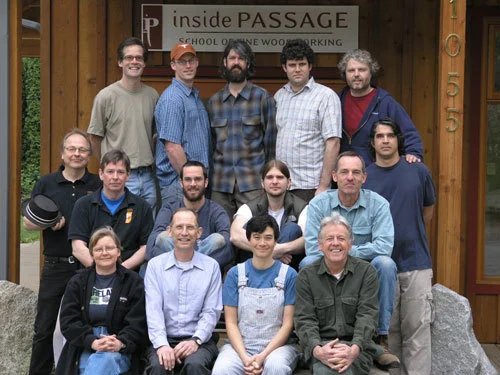


 My how time flies by! We have just completed our ninth week of the Craftsman Program and students are nearing the completion of their fundamental skills before moving onto our first project. Since our last newsletter, students have been busy completing a number of exercises.


 Students were shown the process of cutting through and half lapped dovetails and were given the opportunity to practice these skills before moving onto drawer making and fitting.


 The wood behaved well and moved very little. Robert shared with the class the traditional method of making these planes before demonstrating a method he developed since he began teaching.
 Plane and tool making will be an ongoing activity throughout the year. Already several planes have been made including smoother, Jointer, Scraper, compass, and spoon bottom. One student has even undertaken a plane less than two inches long for detail work. He will have to make an iron and cap iron of less than half an inch in width for this plane. This coming week, chair scrapes will be made. Chair scrapes can be used in shaping and surface preparation of even the most difficult woods. As the students will be making brass knife and “L“ hinges for their projects, this exercise also serves as an introduction to working with brass.
 Thanks giving supper was held at the Van Norman’s, where a crowd of over more than twenty students, their families, and friends gathered to share wonderful food and conversation. Michael Mulrooney turned thirty-nine on the 20th of October. As is tradition, it was the previous birthday person’s responsibility to provide the cake. Jason made a cake in the shape of a wooden hand plane, including milk chocolate cross pin and iron, white chocolate cape iron, and orange peel shavings. Jason’s skills clearly extend beyond the craft of woodworking and Michael has a tough act to follow
 This month we began “walk-arounds” which, once projects are underway, will become a weekly activity. This month Cody Bradford, one of our Resident Bench Craftsmen, shared with the class his pear, apple, satin walnut, and shoji wall cabinet. Cody began by showing us his sketches, the mockup, and then the actual piece underway. The cabinet is full of lovely curves and fine details and will be presented at our first faculty-student show and open house on January 28, 2006.The students found Cody’s presentation very thorough and worthwhile. Pete Heilman, our other Resident Bench Craftsman from New York, shared with us the alter he is making which will soon to have a home in a local church