Author: robert@insidepassage.ca

  • 2005 — 2006

    Advisor

    James Krenov — United States

    Resident Craftsman & Teacher

    Robert Van Norman — Canada

    Admissions & Student Services

    Yvonne Van Norman — Canada 

    Relief Teacher

    Gary Kent — Canada

    Guest Faculty

    Michael Burns — United States
    Julie Godfrey — United States
    Ejler Hjorth-Westh — United States
    Steve Skonieczny — United States
    Todd Sorenson — United States

    Resident Craftsman

    Cody Bradford — Canada
    Pete Heilman — United States

    Craftsman Program

    Brent Currey — Unites States
    Erik Deklavs — Canada
    Stephen Esdon — Canada
    Nicole Field-Dyte — Canada
    Ian Godfrey — Canada
    Doug Ives — Canada
    Jason Klager — Canada
    Caitlin MacIntosh — United States
    Federico Mendez Castro — Venezuela
    Michael Mulrooney — Unites States
    Bruce Rigby — Canada

    Artisan Program

    Owen Konski — Canada

  • Brent Currey — Bainbridge Island, Washington, USA

    I met Robert a few years ago when I took a two-week beginning woodworking class at a school in Ontario. I was greatly impressed with his skill and his teaching style and thoroughly enjoyed the course. When I was considering taking another course I learned that he had opened Inside Passage. Since I was very interested in taking another course from Robert, and since it is so close to where I live, I decided to take a one-week course from him in the summer of ’05. While there, I decided to take the nine-month course that fall. I wasn’t working at the time, and didn’t really have any other commitments, so it was an easy decision for me.

    I have to say that my time there was an experience of a lifetime. People arrive there from many different situations and backgrounds, but I considered myself pretty fortunate, at age 51, to be able to just drop everything on short notice and take a 9-month woodworking course. There was a real excitement in the beginning, I think partly because we were the first class to go through the program. I’m sure every class has its own dynamic, but as a group we really seemed to come together from the beginning, and throughout the course we enjoyed a supportive, creative environment. Of course, Robert’s teaching style had a lot to do with fostering that environment. The result is that you learn a great deal from your fellow students, from their good ideas, their successes, and even their mistakes. This is implemented formally in the weekly “walkarounds” where each student talks about the progress of their project, but it also happens on a more informal basis because you are in such close contact with the others and naturally curious about their projects.

    As far as the technical skills gained through the program, I feel it was a bargain. I suppose some people can teach themselves the skills, or possibly learn through an apprenticeship, but it was unlikely that I would have ever learned on my own what I took away from that course. It gave me a confidence that I lacked. I didn’t know much going into the course, but now I feel that I know how to approach all phases of a project, from concept to completion. We learned a great deal about design. Not just an aesthetic sense, but how to go from idea to sketches, to mockup, to final design, and how to evaluate the design and look for subtle changes that can affect the overall feeling of the piece. I also have a much better understanding of the overall process of furniture building. I now know how to use tools effectively, and how to modify them or make my own for special tasks. When I returned to my shop after completing the course, I noticed that it was almost as if my hands knew what to do without me having to think about it. Don’t get me wrong, I feel that I still have a lot to learn, but I know that this will come from experience. The course let me take a leap to a level of skill and confidence that would have taken me years to achieve.

    Roberts Creek is in a beautiful area, and the town itself has a real charm and friendliness. The Pacific Northwest is like nowhere else, and I think people from the East are particularly amazed at its unique beauty.

    As the course progresses, you will spend more time in the shop, including weekends and evenings. But the truth is, Roberts Creek doesn’t offer that many distractions, and the school is where your friends are. At times the course can be stressful, particularly when you are trying to meet a project deadline. But as I mentioned to another student while I was there, if we weren’t working this hard, we wouldn’t feel we were getting our money’s worth.

    Robert and Yvonne are truly kind and generous people who have thrown all of themselves into this endeavor, and it really shows. Being part of that group gave me a real sense of community. In fact, I still visit occasionally to try to keep that connection and always come home feeling inspired and recharged.

  • May 11, 2006

    May 11, 2006

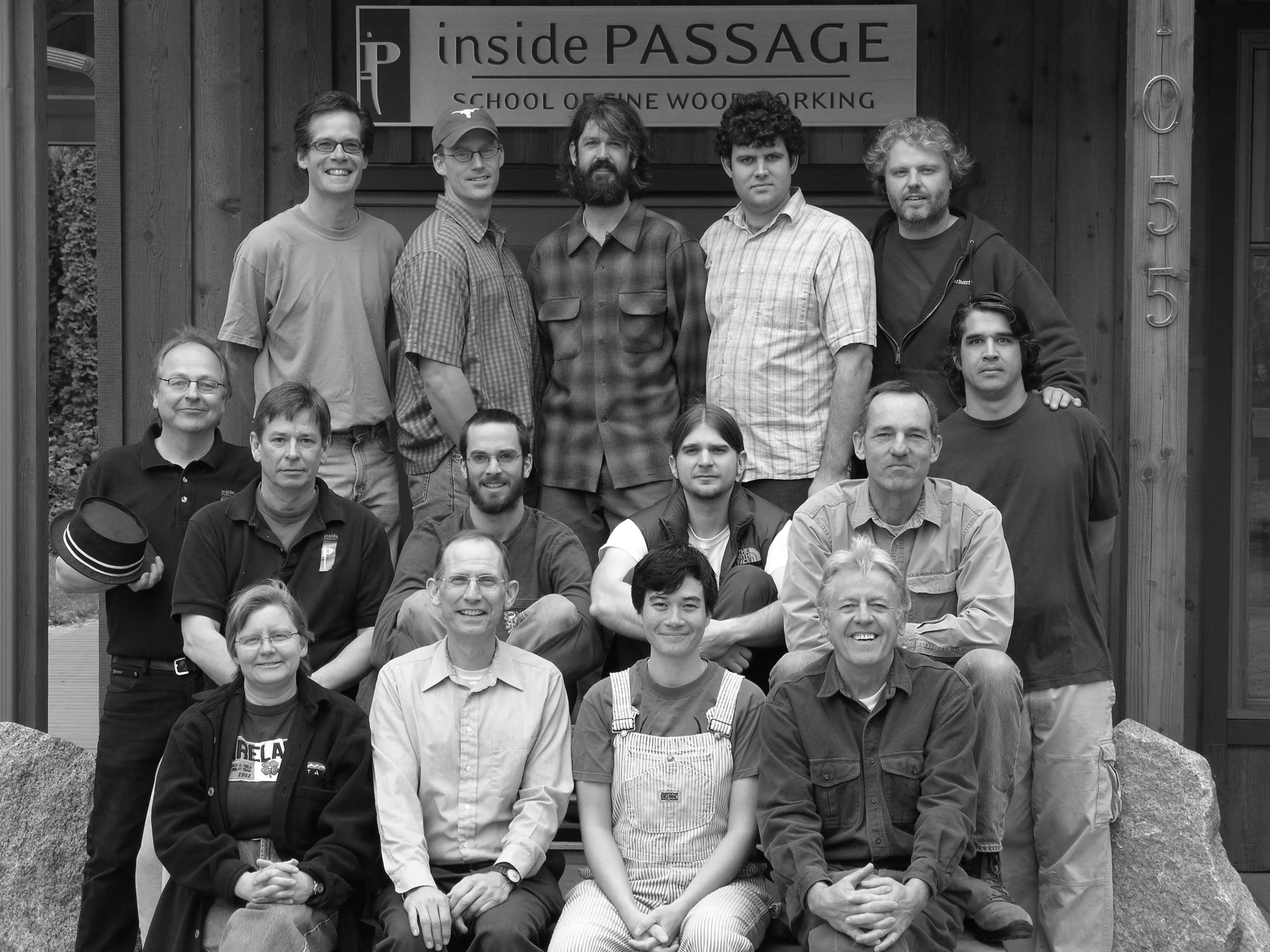
    The First Craftsman Program Graduating Class of Inside Passage School of Fine Woodworking. Our first annual year-end student show took place at the Northwest Furniture Gallery May 11th-18th in Seattle, Washington.

    The Benchroom this week …

    May 11, 2006

    Second Piece, a parquetry cabinet by Federico Mendez Castro. Federico is one of three students who are returning for a second year of study. The cabinet is made using shop sawn veneers laid up using geometric patterns utilizing the flow of the grain graphics, patterns and color. This workmanship of this piece is exquisite. All student final piece will be professionally photographed and will be posted in the student gallery.

    Doug prepares for his valedictorian speech which he made during the show in Seattle. Doug used the opportunity to reflect back on the year which has been a life changing experience for many of our students. Robert was grateful to have such a special group of people as our first graduating class, even more grateful that there was such interest in the Resident Craftsman Program. In the Resident Craftsman Program students contribute to the teaching, thus broadening the experience for first year students, not to mention freeing up Robert to work at his bench.

    Steve Skonieczny, one of our guest faculty, arranged a series of shop tours which took place in and around Seattle the day following the show opening. This photograph was taken outside the Shop of Robert Spangler, a craftsman who resides on Bainbridge Island and displays his work regularly at the Northwest Furniture Gallery. Bob and his wife generously opened up their inspiring home and shop and shared with the students his work as an independent craftsman.

    Another Shop the students toured is that of Bill Walker, a graduate of the College of the Redwoods back in 1981. Bill has been published in Fine Woodworking Magazine and is a regular at Pritnam & Eames in New York. Bill also shared with the students his strategies for making a living as a craftsman.

    The Benchroom this week …

    May 1, 2006

    The students are working frantically to complete their pieces for our Join us at our year end show at the Northwest Furniture Gallery in Seattle. Join us there on Thursday May 11 at 6 pm. for our opening and reception.

    Caitlin’s wooden smoother and shooting board made in the early part of the program have served her well. Caitlin has a curved front tray underway to fit into her first piece.

    Jason’s final glue up. With over a hundred dowels it was a team effort. The fit was very well. We have come to expect this from Jason’s work.

    Jason’s cabinet showing the the curved glass panels. As I write this Jason is mortising the door frames which will accept the carved pulls.

    One of Michael’s doors of Doussie and spalted maple of his linen cabinet. The Maple veneers are slightly thicker with softened edges and have been inset using a portion of the live edge. The careful use of graphics contribute to the taper of this piece, lovely work!

    Brent mortising curved rails of his demilune table. A simple jig holds the aprons at the appropriate angle for mortises. Brent used a full size drawing to work out the angles and for cutting the pieces to size. Brent has used twin and stepped mortise and tenon construction. Brent has already planned on returning this fall for our first elephants.

    Federico’s parquetry cabinet in claro walnut with doors, slide bolt and lock fit. Since this photo was taken the doors have received an oil finish and Federico has turned his focus to the stand. To fully appreciate this piece it should be seen first hand. Join us at our year end show at the Northwest Furniture Gallery in Seattle this Thursday for our opening and reception at 6pm.

    Eric’s stand of wenge partially assembled ready for the final glue up. The front rail will be split and receive a gentle arc across the bottom. Eric has had a wonderful presence in the benchroom this year. We look forward to his return as a second year student.

    Bruce’s curved front drawer joinery complete. Since this photo was taken he has moved onto the drawer bottoms. Bruce has shown remarkable improvement since the beginning of the program.

    Doug’s serving tray stand ready for final cleanup. The tray is receiving the applied edges and Doug has begun the joinery for the curved front drawer which can be accessed from either side. The shaping of this piece is lovely.

    Michael’s cabinet parts receiving a final coat of finish before assembly. The spalted maple can be a real challenge. Michael had to apply five coats of brushing lacquer before applying several thin cut coats of shellac. Notice the gentle pillowing shape applied to the legs. Michael has developed into a fine craftsman and we look forward to his return as part of the journeyman program.

    Peter’s humidor or kwila and pau ferro assembled. He has since turned his focus to the drawers which as I write the joinery is nearly complete. Peter has been a real asset to the program and we look forward to his return as part of our Journeyman Program next year.

    Cody’s table top tansu cabinet with drawer joinery underway. Cody has served as a fine example to the other students. Not only is his work good but he is exceptionally fast. When a mistake is made, which isn’t often he puts his head down repairs or remakes the part without compromise. To see him in action come join us for Artisan C – Dovetails and Tool Making June 5th through 9th, limited space available.

    Stephen’s stand receiving final coat of finish prior to assembly. The stand is a combination of veneer and solid construction. He has used Honduras mahogany as the primary wood with doussie and red cabruva. Stephen has shown remarkable improvement this year. Stephen and his partner Susan are in the process of setting up a cooperative shop for graduates of our program just down the road. We look forward to have so many of our graduates sticking around and expect that it will add to the educational experience for our future students.

    Nicole’s tray of red cabruva with micro dovetail joinery. It will receive a bottom of yew and a carved handle. Nicole has a received a commission for a bed and dresser waiting which she will move onto following the program.

    Ian’s sideboard assembled. Ian has turned his focus to the doors and drawers currently underway. The drawers are of the NK design. The sliding veneer doors and drawers will receive a pulls of bocote nearly complete. Ian was our first registration for the craftsman program and has developed into a very fine craftsman. His work has been inspiring and his assistance the the shop has been invaluable and we look forward to having him serve as part of our faculty.

  • April 24, 2006

    Sides of Ian’s sideboard of teak with European beech interior showing mortises, doweling and console holes just prior to assembly. The fit and finish of this piece is exceptional.

    Final curved applied edge is applied to Brent’s demilune tabletop. The applied beech edge was pre-bent using a hot pipe, a method commonly used in instrument making. With much of the surface preparation and finishing complete, Brent is now focusing on the stand joinery.

    Doug’s drawer compartment dry fit. Doug has developed exceptional hand skills since arriving in September. Doug has the substrates prepared for the curved and tapered curly maple veneered serving tray, which will rest above the drawer compartment and will be captured in position using the legs, which protrude the top.

    Jason’s showcase cabinet dry fit showing marquetry. There was a moment of silence in the shop when Jason dry fit his cabinet and removed the cardboard protecting the finished surfaces. We are pleased that Jason will be co-teaching a number of classes here at the school this summer while serving as one of our three Resident Craftsman.

    Caitlin’s bench dry fit. The twin-mortise and tenon joinery is nicely fit with slats of ash set aside to settle. Following the cutting of the joinery, each of the legs where cut on the bandsaw then shaped by hand using a spoke shave. Caitlin has enlisted the services of a local wool artist who will be hand crafting felted wool seat for the bench.

    Bruce uses a set of ducks to layout curve of his wall sconce; which will be made with tapered laminations of wenge. The cabinet is complete with curved front drawers currently underway at his bench.

    Detail of Michael’s spalted maple veneers inset into veneered doussie doors left slightly proud with softened edges. Michael used the double bevel marquetry method with final fitting done by hand using a needle file.

    Nicole shaping yew handle with small spoke shave. Students at Inside Passage are encouraged to develop a sensible balance between the use of hand and machine tools. As we approach the end of this year¹s program I am very pleased to see this progression in our students and delighted to see the fine hand skills they have developed.

    Eric’s table base dry fit. The front rail will be split now that joinery is complete and the bottom section will receive a subtle arc, which is accentuated by the graphics of the wenge. Mockup handles taped in place to curved drawer fronts to be made of sterling silver and African black wood. Eric has served as a fine leader in the benchroom and we look forward to his return for a second year at some point.

    Stephen doweling using horizontal mortising machine. These rails will be joined to the leg using a twin-mortise and tenon joint and attached to the drawer frame with dowels carefully fit. The drawer of this table will be made or doussie and run through the ends. Stephen has maintained the no compromise approach to our craft and it shows in his work.

    With his parquetry cabinet of Claro Walnut almost complete Federico begins to cut the joinery for stand of wenge. Federico brings wonderful enthusiasm to his work and we are pleased that Federico will be co-teaching a number of classes here at the school this summer while serving as one of our three Resident Craftsman.

    Cody’s tabletop tansu cabinet glued up. Cody has applied the edges to the top and has since moved onto the drawers and sliding doors. Cody has experimented and decided on a green/ brown patina for his brass handles. The handles will be surfaces prepared with 400-grit sandpaper and covered in wood shavings mixed in with a Cupric Nitrate solution. Cody will co-teach a class this summer while completing his year of residency at the school and will be returning to take part in our Journeyman Program in the not so distant future.

    Peter’s wall hung humidor glued up with lower partition. A humidor has several functional considerations, which can significantly impact the design. Peter will be returning to Brooklyn New York following the Seattle show where he will work independently as a craftsman. Peter will be joining us in the future as part of our Journeyman Program.

    With literally Hundreds of dowels, splines and mortise and tenons later, Ian’s sideboard glued up! The top is underway and should be attached in a day or so. At that point Ian will focus on sliding doors and drawers as the show deadline approaches.

    The Benchroom this week …

    April 17, 2006

    Back of Federico’s Claro Walnut parquetry cabinet. When Federico began applying finish to the parquetry panels and the back the tones, figure and grain of this exquisite wood came to life. Watching our students develop their abilities as craftsman is one of the most rewarding experiences a teacher can have. We are so pleased that Federico will be joining us for another year of study.

    Doug’s Serving tray and stand of Jatoba dry fit.

    Doug’s Serving tray: Shows the tight shoulder tolerances of the live twin tenon joinery with shaping complete prior to assemble. Doug spent several days at his bench with a shop made wooden compass plane, spoke shave and chair scrape before burnishing and applying an oil mixture finish.

    Back Panel of Jason’s showcase in East Indian Rosewood and Pear showing curved glass and with marquetry in Imbuya, a suggestion by Jim Krenov. The joinery of this panel includes dowels and micro (1/8″) twin mortise and tenons. Simply put, curves, angles, righteous joinery and sweet surfaces.

    Bruce’s entry table final glue up. Bruce has the Wenge wall sconce underway. The arcs will be made of tapered laminations with an increasingly tighter radius towards the ends. Each of the laminations must be pre-bent using a hot pipe, a method commonly used in instrument making prior to form glue up.

    Walkarounds are a time for sharing and reflecting on the weeks previous work. Brent explains his drawer frame construction during a recent walk around.

    Shaping of legs of Michael’s linen cabinet of Doussie and spalted Maple. The subtle pillowing of the leg and step, just another detail to discover on an impeccably done piece of fine furniture.

    Nicole finishing off the last of the panels of her nightstand of local Cherry and Cypress. Two woods which respond very well to a hand plane. The shavings are indicative of hours of planing. The cherry and cypress is a lovely match. The interior of Cypress will receive just a few light coats of shellac, but not enough to mask the lovely citron fragrance.

    Stephen’s sofa table of Honduras Mahogany and Doussie dry fit. Stephen is currently refining the shape of the legs. Once the case work is complete it will house a through drawer of Doussie that will be aligned using rare earth magnets carefully fit just below the surface of the rails. Stephen has shown remarkable progress as a craftsman since arriving at our school with no prior experience working with wood.

    With her joinery complete Caitlin returns to the serenity of the bench room where she uses a spoke shave to shape the legs of bench of local cherry. After weeks of scraping Muhuhu in her previous piece Caitlin is enjoying the friendly properties of the local cherry. Caitlin has developed fine hand skills since she arrived at our school.

    Ian’s teak sideboard dry fit. The joinery is very well executed, as is the surface preparation.

    Ian’s teak sideboard: Shows the back and side panel construction dry fit with a temporary spline. The panels are doweled into the top and bottom. The legs are attached to the frames using twin mortise and tenon. It will be almost a shame to glue up this piece as it incorporates so many of the methods and skills taught this year. As I watch this piece being made I am reminded of “A Cabinetmakers Notebook” where Jim tells the story of Peder Måås, a well-known Danish cabinetmaker who sent a chair to Orient by ocean freight. As the chair is being unloaded from the ship an elephant steps on it. The only thing left intact is the joinery; the rest was smashed to splinters.

    The parts of Cody’s tabletop tansu cabinet with joinery complete, prefinished and ready for assembly. The richness of the Kwila and Jatoba are brought out using an oil mixture finish. The interior of Spanish Cedar receives only a few light coats of shellac which still permit the fragrance to come through.

    Lip detail of Eric’s entry table top of Wenge. The Case is complete and curved drawer parts cut and ready for hand cut joinery. The stand joinery is currently underway with all the shaping complete. The drop leaf pulls of sterling silver and African Blackwood are underway and serve as a fine after hours activity. Eric has been a tremendous leader in the shop. He does it in a quiet way. Eric has expressed interest in coming back for a second year in a year or two. He will be welcomed back with open arms.

    Brent’s parts with finishing nearly complete. The drawer compartment joinery is complete where the sides are attached to the front apron using half lapped dovetails. Bent has fabricated the jig he will use to cut the twin mortise and tenon joinery, which will be used to join the curved aprons to the legs. The sunburst top is nearly complete with the front steam bent edge banding.

    Pete laying out a mortise for a lock on his Pau Ferro and Kwila humidor. The slot, which will accept the bolt of the lock, must be mortised accurately into the cabinet prior to construction. A series of partial mock-ups determine the placement of the lock.

    The Benchroom this week …

    10 April, 2006

    Robert was invited to speak at the recent Vancouver Island Woodworkers Guild. With nearly two hundred in attendance he spoke about our school and his passion for craft. He was reunited with a few former students and looks forward to returning for the Furniture Society Conference which is being held in Victoria Summer 2007. As a graduate of the College of the Redwoods Fine Woodworking Program, Robert received an invitation to submit work to the Highlight Gallery’s 25th Anniversary show to be held in Mendocino September 2007.

    Robert demonstrating cutting mortise for wall hanger on the horizontal mortising machine using an end mill.

    Gary and Doug discuss construction of framework of drawer compartment of Doug’s serving tray stand. Walkarounds continue to be an educational and entertaining aspect of the program.

    Ian’s teak sideboard bottom showing twin mortise and tenon joinery, bake ins and spline joinery. Complete with European Beech interior and Bocote pulls this Danish inspired sideboard will shine with Ian’s fine craftsmanship and attention to detail.

    Michael’s rails of doussie linen cabinet showing twin mortise and tenon and spline joinery. Michael has been busy with surface preparation and finishing while completing his joinery. Michael continues to develop into a fine craftsman.

    Stephen’s Table Aprons with oil mixture finish. Two planks of mahogany have been used for this table. The first plank has been used for the legs and frame work the second for top and aprons. Stephen has shown remarkable progression this year. He approaches his work in a thoughtful way and is evident in his work.

    Caitlin’s twin mortise and tenon joinery of local cherry bench. Each of the floating tenons are fit to each specific mortise using files, planes and sandpaper; which when fit well produce “pop” sound when removed.

    Back panel of Federico’s parquetry cabinet of Claro Walnut and Wenge. Unfortunately no picture will ever do this piece any justice. The wood and craftsmanship are impeccable.

    Doug’s tray showing tapering or substrate laminates prior to baked in edges. Doug has already cut the curly local veneer for this piece and will receive applied edges of Jatoba.

    This week Robert demonstrated making knife hinges, “L” hinges and wall hangers. Shown are some of the simple tools required and a few of the hinges completed and others partially complete.

    Peter’s humidor of pau ferro and kwila showing fit of bottom into pre finished side and post. The top and bottom are notched for the legs then doweled using a simple doweling template. Peter will make the transition to self employment as a craftsman following the program upon his return to New York.

    Eric’s wenge cabinet ready for drawer fitting. The elegant legs have been shaped using planes, spoke shaves and scrapers are shown to the left. The silver drop leaf pulls will be carved and polished using simple hand and machine tools.

    Jason’s showcase of pear and east Indian Rosewood showing twin tenon compound angled joinery. The workmanship of this piece is exquisite. Jason’s curved glass arrived this week. His frames are currently under construction including twin micro (1/8″) floating mortise and tenon joinery.

    Brent’s demilune table top of curly and spalted local maple. A lot to consider when laying out the shop sawn veneers for this piece. Color, grain and graphics joined with tapers narrowing towards the sides of the table.

    Brent’s demilune aprons showing half lapped dovetails where sides of drawer compartment are joined. Brent will use twin mortise and tenon construction to join the aprons to the legs.

    Bruce’s entry table in kwila showing side corner and back lip. With finishing almost complete Bruce has begun preparation of forms for tapered lamination base to be made of wenge.

    Nicole hand planing applied edges of her night table of local cherry. She has her stand material, Jatoba has been cut and settling while she continues to work on the cabinet. Our local cherry reminds me of Euro cherry which I have not seen available for some time.

    Sides of Cody’s tabletop tansu of Kwila and Jatoba. There is a slight taper to the legs and side panels. The interior is of Spanish cedar. It will have two sliding doors veneered doors, three drawers with pulls to be made of patinaed brass.

    Doug’s serving tray frame partially finished and dry fitted. The shaping on this stand was done using planes, spoke shaves and chair scrape and is a joy to see and feel. The tones of the Jatoba and local figured maple are a fine match.

    The Benchroom this week …

    April 3, 2006

    The students and faculty sat down one evening and discussed ‘Life After School ‘. During this session, the realities, both challenges and benefits of life as an independent craftsman were shared. We are excited to announce that Stephen Esdon and partner Susan will be setting up a woodworking cooperative shop just down the road for graduates of our school. Stephen and a few others recently ordered workbenches from Leif Carlson of Sweden. Leif is the son of the craftsman who made JK’s bench and has also made a bench for Robert. Over the coming weeks students will be introduced to the making of hinges and handles of brass and silver, chair making and marquetry as well as sliding doors.

    The students are taking advantage of the after hours time being offered at our school to complete their final projects to be shown at the Northwest Furniture Gallery in Seattle on May 11. Steve Skonieczny, one of our journeyman program teachers has arranged for a number of shop tours and has contacted the gallery membership to find accommodation for our staff and students. The students are also looking at the possibility of a year-end road trip to meet Jim Krenov and visit the place where it all began. A preview of year-end work will take place at our school the week prior to the Seattle show. Stay tuned for more details.

    Ian’s teak cabinet showing joinery and step on the legs. The teak is a joy to use. Although tough on cutting edges it work beautifully with both hand and machine tools. Ian has begun pre finishing his components and has the majority of machine work behind him. He will be using NK drawers in this piece.

    During a recent walkaround, Cody shares the mockup of a tabletop tansu cabinet to be made of Jatoba and Kwila. This cabinet will have three drawers and two sliding doors.

    Bruce’s entry table of kwila with wall sconce mocked up in poplar. The stand will be made of tapered laminations, likely using Red Cabruva. Bruce’s attention to detail is evident in his work.

    Caitlin’s mockup of bench to be made of some sweet local cherry with carded wool seat. The bench does not have a back and can be placed against a wall or in the middle of a room. Caitlin and her partner Ellen have two lovely little girls who I am sure will enjoy their Caitlin’s work.

    Stephen’s mockup of sofa table to be made of Honduras Mahogany and Doussie. Stephen has his veneer work complete for the top and aprons and has begun the shaping of the legs. He is enjoying the workability of the Honduras Mahogany.

    Doug’s stand of Jatoba with joinery carefully fit. A challenging wood and joinery. The parts have all been carefully shaped by hand using spoke shaves, planes and chair scrapes made during the program.

    Robert talking about template routing on the shaper, a method used commonly in chair making.

    Jason using a double template for initial shaping of his legs. Jason has taken on a very complex piece. He has developed exceptional hand skills since arriving at the school and we look forward to big things from this young man when he returns for a second year of study.

    Pete’s kwila chair complete with Danish Cord. A finely made chair by a very skilled and dedicated craftsman. Once complete, Robert sat in it for about an hour preparing for the day. The ergonomics match the strong aesthetic value of this piece. Pete will be returning to New York following the program where he will be sharing a shop with another furniture maker. Pete has begun a humidor in Kwila, Pau Ferro and Spanish Cedar.

    Brent top receiving baked in edges. As the curve towards the outside becomes quite tight each edge was bent using a steam pipe so as to make the curve without fracturing. Brent’s celebrated birthday his birthday with us this week. Once with the class and again with Loragene & Philip Gaulin who operate a B & B where Brent is staying. Loragene made a fabulous homemade chocolate cake.

    Nicole’s veneer work in the press. Nicole has done a fine job sawing and preparing the veneers for this piece. The exceptional local cherry and cypress work very well together. The cypress, which will be used in the interior of her nightstand with perhaps a thin coat or two of shellac, has the fragrance of citronella.

    Michael’s rails showing twin tenon joinery of Linen Cabinet. Michael has his panels veneered and has even mocked up a drop leaf pull of patina brass which works very well with the doussie and spalted maple. Following the Craftsman Program Michael will be moving into a teaching role. His abilities as a craftsman will be complemented well with his ability to work with people.

    Jason’s shop drawing of the stand for his cabinet. Compound angles and curves. Not at all as simple as the drawing looks not to mention it is being made of Indian Rosewood.

    Eric’s wenge cabinet dry fit. This week he received the silver, which will be used to make the posts for the drop leaf pulls. African Blackwood will dangle from the silver posts, which complements the wenge.

    Federico’s applied edge, notice the alignment with veneer of front of door. Federico has done a fabulous job with this challenging piece. He brings a great deal of creativity to his work; at the same time working very accurately.

    Brent’s aprons, drawer fronts and frames laminated prepared for joinery. The highly figured western maple used in the aprons and drawer fronts will also be used for a sunburst pattern on the top. Check back next week to see the progress.

    A side of Eric’s table showing baked in, applied edges and doweling. Each of these sides is made up of sixteen pieces of wood including Baltic Birch plywood and Italian bending Plywood.
  • March 13, 2006

    Ian shoots the edges of his beech veneers for the interior of his teak sideboard. With much of the machine work for this piece already complete he will enjoy the serenity of the benchroom.

    Side construction detail of Eric’s cabinet. Construction details such as this are never seen but gives the maker the peace of mind the furniture made will be enjoyed by generations to come.

    Nicole scrubbing local cherry plank for a closer look at the grain before cutting edges and veneers. Nicole has selected local cypress for the interior of her night table. The cypress has many of the tones in the cherry and will lighten up the interior of the cabinet. The smell of the cypress coming off the saw reminds one of citrus. Since this photograph was taken she has cut stacks of veneers in both the cherry and cypress.

    Bruce’s entry desk parts veneered and ready for applied edges. Bruce has done a fine job selecting the material for his piece and practices a sensible balance with hand and machine tools.

    Robert and Federico discuss the construction details of his parquetry cabinet.

    Stephen shaping the leg for mockup of hall table. On his bench “ducks”, used in lofting in wooden boat building were donated to the school by Ejler Hjorth-Westh and are used to layout curve of leg.

    Robert vacuuming out the interior filters in dust collector. Dirt jobs at our school are shared by all.

    Pete working out the details of humidor to be made of kwila and pau ferro. Pete’s kwila chair is nearing completion with only the Danish cord seat left to wrap. Pete will enjoy a break from laminations and compound angles while he dives into veneers, and drawers.

    The Benchroom this week …

    March 6, 2006

    Todd Stockner and Jason discuss veneer. Todd, a graduate of the College of the Redwoods Fine Woodworking Program, visited our school this week. We look forward to Todd’s return when he takes part in our journeyman program this fall.

    Brent’s mockup of demilune hall table to be made of curly western maple and beech. One of the most difficult design considerations in a table like this is leg placement. Brent has the working drawing complete and has begun looking at the wood.

    Robert uses a simple honing jig to touch up jointer and planer knives after Ian’s teak veneers. The knives are fit into slots that are cut at one degree less than the bevel angle on the knives. A diamond stone is set across both knives and a scrubbing action is used to raise a burr followed by a 8000 grit water stone. After removing the burr this process produces a micro bevel edge capable of a producing a very fine finish. This allows us to get a couple of honings out of each grinding.

    Walkaround this week with special guest John Barton (seated on far left). John was Doug’s woodworking teacher in Nelson British Columbia back in the nineteen seventies. John was joined by Ted and Francis two of Doug’s classmates.

    Doug shares with the class a photograph taken of John Barton and Jim Krenov taken in 1982. John is considered by many as one of the pioneers of craft education in Canada.

    Michael’s doussie and spalted western maple veneers for doors of linen cabinet. The live edge of the spalted maple veneer will be kept and will be inset into the kwila using marquetry methods. These veneers will also be kept slightly proud of the doussie, just another one of those details…

    Stephen presenting his cabinet to the class. Stephen has learned a great deal from this piece. The drawers fit with the precision of pistons. As each one is closed a flow of air at the back of the pocket causes the other to open.

    Caitlin presenting her cabinet of muhuhu and zebrano to the class. Many lovely subtle details in this cabinet made of two complementary and sustainable African woods. The cabinet will be used to hold handmade necklaces her partner Ellen has collected in their travels.

    Brent presenting his cabinet of anegre and olive to the class. A fine piece of work made by a fine member of our community. Brent shared a passage from A Cabinetmakers Notebook which described his journey.

  • February 27, 2006

    Robert demonstrating steam bending. Ironically enough, the only time he recalls using this method was to straighten out a piece of Cuban mahogany for the edge of a desk that moved when it was resawn. With that said for subtle curves in thin wood such as the back splats of a chair it is an alternative method to bent laminations.

    Bruce’s kwila laminated drawer fronts in form. Bruce has the substrates complete, veneers cut and cleaned up with a scraper plane. With pressing underway he will move onto doweling over the next few days.

    Pete assists Eric during the glue up of wenge laminations. Eric has chosen a challenging piece that includes a set of pulls he intends to craft in silver.

    In The Impractical Cabinetmaker, Jim Krenov writes about composing, an alternative approach to design. Federico shares the composition of his door and cabinet side veneers with the class. Federico has a fine eye and attention to detail. The flow of the grain of the doors gracefully wraps to the sides of the cabinet.

    Cody’s mockup of Tansu cabinet. Veneered doors below, sliding doors above right and lots of drawers. Something that Cody has become quite proficient at.

    Michael’s mockup of Linen cabinet to be made of doussie and spalted maple. With his mockup complete Michael has moved onto his shop drawing, and substrates. This piece was inspired, as many of our pieces are, by a sweet piece of wood.

    Ian taking stock of built-up substrates with baked in poplar edges and cross checking with his working drawing.

    Doug using a compass plane to fair the curve off the bandsaw. In the words of Elbert Hubbard, “One machine can do the work of fifty ordinary men. No machine can do the work of one extraordinary man.”

    Ian and Robert look at the graphics of his shop sawn teak veneers. Careful selection of the materials is an aspect we emphasize at our school and shows in the work produced by our students.

    An evening session at the school. Robert shared a slide show with the students courtesy of Jim Krenov. Following the slide show Robert demonstrated installation of multiple glass panes in a small door frame of doussie. Robert also demonstrated the making of consoles, or shelf supports, a process he still enjoys very much.

    Our weekly walk-arounds give students the opportunity to share their work with the class. As amusing as they are educational, they are a time that we all look forward to.

    Pete shares his kwila chair with the class during walk-around. Once assembly is complete the seat will be wrapped in Danish cord. With the split lower rail this will be a challenge. Pete has already begun mocking up a humidor to be made for a client in New York of Kwila and Pau ferro.

    Jason cutting parts for his stand of Indian Rosewood to allow them to settle while he continues his pear cabinet with marquetry.

    Caitlin’s carved muhuhu necklace hanger carefully fit. Facets have been left from the knives and gouges, fingerprints left by the maker.

    Nicole presenting yew box to the class. The carefully fit joinery, integrated carved pulls and impeccable craftsmanship shine in this piece.

    Michael presenting his cabinet to the class. A touching presentation by a fine craftsman and a thoughtful man. We are fortunate to have Michael moving into a teaching role at our school in May.

    Next week we move onto NK drawer construction. A drawer developed by a Swedish Manufacturer Nordiska Kompaniet. On applications where the drawer is wider than it is deep they improve performance and longevity. Check our website next week for details.

    The Benchroom this week …

    Feb 20, 2006

    This week students were introduced to tapered laminations including applications, form and sled making, preparation of laminates and gluing strategies. Next week we will be moving onto showcase cabinets. Jim Krenov has passed along many of his his slides including a series which show the progression of his V front showcase. Robert will present the slideshow and demonstrate and discuss glass applications in fine furniture.

    Steve Skonieczny, a classmate of Robert’s from the College of the Redwoods, is the second visiting craftsman take part in our Journeyman Program at the Inside Passage School of Fine Woodworking. Steve arrived at a time with many second project mockups underway. He is a fine craftsman with a good eye who enjoys sharing his knowledge of our craft. Steve brought along a commissioned piece; a painting box of Macassar Ebony and shared with the class his inspiration for the piece as well as his interactions with his client. Steve lives in Seattle, Washington with his wife Barb and one year-old-son Simon. We look forward to regular visits from Steve and his family.

    Steve discussing mockup with Doug

    Ian presenting his cabinet to the class. The back panels are of anegre, a gift from Brent. Ian followed our criteria for his first piece. As Michael Burns suggests “Small Simple, Solid & Sweet”. His second piece will be everything but small, simple or solid. A sideboard of teak will build upon previous skills covered in the first semester and incorporate many new skills covered in our second semester.

    Drawer detail of Eric’s mockup including the concept of a pull to be made of brass and wood. Hardware making which includes hinge making and the making of pulls and latches of metal and wood is covered in our second semester. Eric hit the ground running after his thoughtful presentation of his first piece to the class earlier this week.

    Jason’s practice marquetry exercise showing the branches to be done on the panels of his pear showcase. The palette of woods in the background will be selected from for the leaves. Jason presented his first piece to the class earlier this week, has already mocked up his second piece and is knee deep in veneers.

    Jason discussing his mockup with the class during walk around

    Federico enjoying the natural light while exploring the possibilities for his parquetry cabinet. Eric’s mockup in background.

    Pete’s chair parts with joinery and surface preparation complete ready for pre-finishing.

    Curved side panels of Bruce’s entry desk of Kwila showing core substrate construction ready for vacuum press.

    Claro walnut shop sawn veneer arranged for parquetry cabinet door. Federico uses a mirror to help visualize second door. Parquetry requires many considerations including grain graphics, color and tone. Federico’s passion for sculpture is as evident in this his second piece as it was in his first piece which he presented to the class earlier this week.

    Michael’s cabinet complete with pulls of Kwila

    The Benchroom this week …

    Feb 13, 2006

    This week, having completed a shop sawn veneer exercise, the students were introduced to form making and curved panel work. Next week we will be moving onto Tapered Laminations.

    In the second semester students build upon previously covered material and with their second projects underway continue to be introduced new topics each week. In addition students continue to take part in our weekly walk around where students have the opportunity to learn through the experiences, triumphs, failures and recoveries of their fellow students work through individual pieces.

    We began this week visiting Robert Prinse a local sawyer and friend of the schools. After a day of looking through many stacks of local woods including spalted and figured maple, Claro walnut, Apple, Locust and Pear, we meet family and friends at Anton’s Pasta for a wonderful meal.

    Students with Robert Prinse, a local sawyer and friend of the school. For many years Robert made a yearly Pilgrimage to the College of the Redwoods to peddle some of the finest local figured and spalted woods.

    Michael and Nicole looking through flitch cut 12/4 local cherry. Among the nicest I have seen.


    Family and Friends join for Dinner at Anton’s Pasta restaurant.

    Flitch cut planks of local curly and spalted maple almost ten feet in length, two feet wide and almost three inches thick.

    Pear plank, one of three flitch cut from our stock.

    Pete fitting the arm to front leg on chair of kwila. The seat will be of Danish cord. Each of the back splats are tapered laminations, thinning out towards the middle. Twin mortise and tenon construction. Many subtle details in this incredibly comfortable chair.

    Brent fitting tails for one of two drawers of Anegre with olive pulls. Brent will begin to mockup a demilune hall table with a drawer likely to be made of highly figured maple with a calm complimentary wood.

    Jason’s mockup of marquetry showcase cabinet of Pear with stand of Palasander Rosewood.

    Ian in foreground working out the joinery details on shop drawing of Teak sideboard. Stephen cleaning up dovetail joinery in drawer of curly maple and Spanish cedar.

    Bruce presenting his cabinet to class. The workmanship of this cabinet is without compromise. When the drawer tray is set into the drawer it drops on a cushion of air…very sweet!

    Doug presenting his cabinet of Aframosia, London Plane, Sycamore, Wenge and Tasmanian Blackwood to the class. With projects complete students are asked to present their piece to the class. This is a celebration where students share with the class, family and friends inspiration for their work, what they have learned and have the opportunity to share a passage from a favorite book. As many of the pieces were finished just prior to our recent student show, we have many presentations over the coming week.

    The Benchroom this week …

    Feb 06, 2006

    Real Veneer

    This week students were introduced to the possibilities which exist outside the realm of solid wood. At our school, students saw their own veneer. Many have begun to mock up second pieces, many of which include veneer work and some even parquetry and marquetry, which will be covered in the coming weeks. With their first piece complete, the scale of work will increase as will the level of complexity.

    Ian’s mockup for a sideboard. The carcass will be of shop sawn Teak veneer. Sliding doors can be shifted for flexibility of use. Ian took full advantage of our evening and Sunday hours in preparation for our recent student show and open house. He will need to continue to do so to complete this rather large piece for our year end show which takes place in May at the Northwest Furniture Gallery in Seattle. If Ian’s first cabinet in Doussie and Anegre is any indication, impeccable craftsmanship, careful selection of material and attention to detail will be most evident in this piece.

    Jason’s mock up for cabinet in Pear showing curved glass and marquetry panels. The stand will be of a wood yet to be decided. A challenging piece by an emerging craftsman. We look for wonderful things from this young man in the years to come.

    Claro Walnut crotch, a starting point for Federico’s parquetry cabinet. A gift from Robert, a piece he has carried around for more than fifteen years. As with much of the work we do, the wood speaks and we do our best to listen.

    Peter Heilman, one of our Resident Craftsman, mortising parts for a set of chairs in Kwila. After students have a handle on free hand mortising the XY table is introduced. The interesting thing is that once students have learned to enjoy the simplicity of freehand mortising many are reluctant to move onto the XY table. Peter combines the sensitivity of freehand and the efficiency of the XY table in his work. Jim Krenov continues to use the free hand method for all his work.

    Doug’s cabinet with handles of Bocote in place. The handles are a variation of the post and bail pulls that Jim Krenov has used on many of his cabinets. The post and bails are joined together and fastened to the doors using very small live through tenons. The bails, the cross pieces are carefully shaped and carved using small knives and needle files.

    Nicole’s dovetailed box of yew. With handles carved the fitting of the lid underway. The warm tones of the yew and fine craftsmanship shine through in this piece.

    A beautiful winter day at Inside Passage School of Fine Woodworking. With the busy days and nights spent at the school we sometimes forget about the beautiful, quaint and magical place in which we live.

  • January 23, 2006

    This week we have photographs of the details of the pieces on display to show the quality of the work produced by our students. Photographs of the students and their work are shown in the Student Collection and Resident Craftsman Collection of our Gallery page. (more…)

  • December 30, 2005

    Federico sharing his wealth of knowledge on the woods of South America. Federico has been a wonderful resource for all of us at Inside Passage School of Fine Woodworking.

    Roberts Creek at low tide. This shot was taken by one of our students taking a mid afternoon break. The beach is located just a few minute walk from the school offering the students and faculty a source of inspiration as well as a wonderful place to unwind.

    Michael’s mockup in alder. With all the details worked out he is now making shavings. A commissioned cabinet to be made in agathis, cypress and yew.

    Federico and Robert taking a break to enjoy a pleasant after hours activity. Students at Inside Passage School of Fine Woodworking attend class Monday thru Saturday from 8am to 5pm. In addition they have access to the school for hand tools only from 5pm to 10pm.

    The first piece to be presented at Inside Passage School of Fine Woodworking. Peter’s alter a commissioned piece will have a home just up the coast from our school. His no compromise approach of this piece has raised the bar for our students. Our resident program has enriched the learning experience at Inside Passage.

    Alter in place at a church just down the road from the school in Davis Bay British Columbia. The Baptismal font has since been delivered. Watch for photographs of the alter and font presentation to take place at the church in the New Year.

    Nicole, Cody & Michael now that’s teamwork. Nicole and Michael assist Cody in the final glue up of tea cabinet which will be on display along side student work at Inside Passage School of Fine Woodworking Gallery and School open house on January 28, 2006. He only has ten drawers to make and finish the door. Cody will have a busy January as will most of us.

    Jason’s mock up of tea cabinet in poplar. Students spend time to work out the details on these full size models before moving onto actual piece. This cabinet is currently underway in doussie and tiger myrtle. Exquisite wood, exceptional craftsmanship.

    A school visit to local woodcarver Bradley Hunt.

    Brady Hunt shares his inspiration in his humble shop. Bradley and his two sons Shawn and Dean are working on a large commission while their new shop is under construction in Davis Bay. Bradley’s attention to detail, use of material and passion for his craft are truly inspiring.

    When the last of the students had left for break I sat at my bench looking back at all the students have accomplished over the first semester. I was filled with a deep sense of satisfaction and pride of the accomplishments of this years class. The tradition of craft education began by James Krenov twenty five years ago is as strong today as it ever was. On the 4th of May 2006 our year end show will take place at the Northwest Furniture Gallery in Seattle Washington. Featuring current work of Inside Passage Faculty, Resident Bench Craftsman and of course the students final pieces. A preview of these pieces will take place at our gallery prior to the show. From all of us at Inside Passage School of Fine Woodworking Seasons greetings and a wish for Health, Happiness and Peace in the coming year.

  • October 31, 2005

    Eric preparing for sawhorse glue upMy how time flies by!  We have just completed our ninth week of the Craftsman Program and students are nearing the completion of their fundamental skills before moving onto our first project.  Since our last newsletter, students have been busy completing a number of exercises.

    After covering the “sport” (as one of our students refers to it) of free hand mortising, students had the opportunity to put this and other skills previously covered to use making a set of sawhorses from hard maple.  With through and wedged mortise and tenon construction, hand planed surfaces, and friendly edges and corners, these sawhorses are as beautiful as they are practical.

    Ian's fitted through mortise & tenonMichael's paring chisel

    With this exercise underway, students were introduced to tool making.  Each student had the opportunity to make at least one, more often than not several, chisels using old files.  The file is first softened, a process known as “annealing”.  The file is then shaped and an initial flattening of the back is completed.  The tool is then hardened, tempered, and honed before a wooden handle is attached and shaped.  We then moved onto dovetailing where the students were able to put some of these tools to use.  This inevitably leads to more tool making.

    Doug cleaning up pinsIan paring tails of drawerStudents were shown the process of cutting through and half lapped dovetails and were given the opportunity to practice these skills before moving onto drawer making and fitting.

    Mark Safioles, a local woodworker who has taken summer programming at the College of the Redwoods, made our wall hung tool cabinets with a small drawer pocket with let go.  That is, the pocket is tapered and slightly wider at the back than at the front

    Students each made a drawer with a solid fielded panel bottom, fit the drawer to the pocket, carved a pull, and attached the pull with through and wedged mortise and tenon.  When the drawer was carefully fitted, a slight taper was planed into the sides (front to back) so when removing the drawer from the pocket, the drawer gets snug just before it reaches the end of its run.  When closing, the piston fit air cushions the final run of the drawer just before it reaches the small wooden stop carefully fitted behind the drawer front.  Drawer fitting requires sharp tools and patience.  The difference between a sweet fit and a sloppy fit can be the matter of only a few fine shavings.  Strategies were shown to compensate for a fit that just gets away.  Mistakes happen, and learning to deal with these hurdles only makes us better craftsman.  In the end, eleven finely fitted drawers will serve to hold odds and ends while at the school.  And more importantly, these drawers will serve as a reference when making drawers in their projects – here at the school and in years to come!

    Doug's walnut drawer with guatambo daffy duck pullMichael's boxwood drawer with carved olive pullRobert's red cabruva drawer with carved jarah pullIan's mahogany chair with carved palasander rosewood

    Bruce's alder drawer with carved cherry pullEric's alder drawer with cocobolo pullNicole's alder drawer with carved pear pullJason's drawer with East Indian rosewood post & bail pull

    In preparation for coopering, which will be covered next week, students learned the process of making a coopering, or round bottom plane.  The school sourced out some beautiful cocobolo wood that, unfortunately, was not dry enough for making planes.  Rather than finding another source, the wood was cut slightly oversized and a make shift low-tech kiln was constructed.  Over a period of a week, we watched the moisture content drop slowly and steadily until acceptable levels were reached

    Ian's spokeshaveThe wood behaved well and moved very little.  Robert shared with the class the traditional method of making these planes before demonstrating a method he developed since he began teaching.

    During this time, students made wooden spokeshaves using Hock low angle irons.  These tools do not replace standard angle spoke shaves but in Robert’s opinion are unmatched when used on end grain or on softer woods.  This process helps develop accurate working habits and familiarity to the horizontal boring machine and drill press.  Students were also shown the process of making cap irons.  With the fine quality irons produced by Ron Hock today, this exercise was one of interest more than practicality.  But nonetheless it presents other possibilities that can be used when standard irons sizes or radiuses are not appropriate for the work being made.

    Jason's small plane showing handmade iron slotPlane and tool making will be an ongoing activity throughout the year. Already several planes have been made including smoother, Jointer, Scraper, compass, and spoon bottom.  One student has even undertaken a plane less than two inches long for detail work.  He will have to make an iron and cap iron of less than half an inch in width for this plane.  This coming week, chair scrapes will be made.  Chair scrapes can be used in shaping and surface preparation of even the most difficult woods.  As the students will be making brass knife and “L“ hinges for their projects, this exercise also serves as an introduction to working with brass.

    Doweling was introduced using a simple low-tech method that provides the maker another effective way of joining both solid and veneered components.  Each student made a small doweled exercise cabinet of poplar that will receive a frame and panel back to be covered early next week.  The use and fitting of partitions will also be covered in the coming days

    Social Activities

    Michael's birthday cakeThanks giving supper was held at the Van Norman’s, where a crowd of over more than twenty students, their families, and friends gathered to share wonderful food and conversation. Michael Mulrooney turned thirty-nine on the 20th of October.  As is tradition, it was the previous birthday person’s responsibility to provide the cake. Jason made a cake in the shape of a wooden hand plane, including milk chocolate cross pin and iron, white chocolate cape iron, and orange peel shavings. Jason’s skills clearly extend beyond the craft of woodworking and Michael has a tough act to follow

    Elephants were held on Fridays, as is tradition.  Pete and Maura held the weekly gathering at their beautiful little cottage, where a few perfect boards were burnt in celebration.  Friends of the school, Martin and Marney (of the Back Packers B&B) hosted a special Elephants at their home where we were joined by two classmates of Robert’s from the College of the Redwoods and their families who also stayed at the B&B. Steve Skonieczny and Carl Zytowski, both of Seattle, are both very fine craftsmen who display their work at the Northwest Furniture Gallery, where our year-end show will take place on May 4-8, 2006(details to follow). Other venues for our weekly Elephants gathering included the common house of Roberts Creek co-housing – Gary and Stacia Kent hosted once, as did Caitlin and her partner Ellen, and their young family.

    Mary Boulding, a friend of the school, teaches Shiatsu here in Roberts Creek. She offered our staff and students a treatment on one Friday afternoon – just another way that the Roberts Creek community has embraced our school and we are most grateful for their support!

    Cody's pear and apple cabinet under constructionThis month we began “walk-arounds” which, once projects are underway, will become a weekly activity.  This month Cody Bradford, one of our Resident Bench Craftsmen, shared with the class his pear, apple, satin walnut, and shoji wall cabinet.  Cody began by showing us his sketches, the mockup, and then the actual piece underway. The cabinet is full of lovely curves and fine details and will be presented at our first faculty-student show and open house on January 28, 2006.The students found Cody’s presentation very thorough and worthwhile. Pete Heilman, our other Resident Bench Craftsman from New York, shared with us the alter he is making which will soon to have a home in a local church

    Pete’s selection of material and “no compromise” approach to the piece is sure to bring him a number of commissions –­ a large piece executed very well.

    The class was treated to a Roberts Creek Co-Housing shop tour where Gary Kent is in the midst of completing a small cherry table and the mockup of a cabinet being made for the school gallery. Also on hand was a large Tansu of yellow cedar recently shown at the BC Wood Coop gallery on Granville Island.  In a little more than a week, Robert will kick off first projects with a slide show and talk about his Red Cabruva cabinet currently underway. The door has been made and fit and curved front drawers are underway. Once complete, he will fit the back before moving onto the stand to be made of doussie. The parts for the stand were cut oversized and have been cut for a few months now so that they have time to relax.

    Our school took part in the annual Surrey Wood Show the weekend of the October 23rd.  Michael Mulrooney and Pete Heilman set the show up and represented Inside Passage on Friday and Saturday. They were joined by Gary Kent on Saturday afternoon. Robert joined Gary for the Sunday. We are grateful to all who assisted in making the show such a success!  A special thanks to Bruce and Nicole who stayed around to help Robert take down the booth, enabling him to get home in time for supper with the kids.

  • September 30, 2005

    On September 6, 2005 we began our inaugural nine-month Craftsman Program at Inside Passage School of Fine Cabinetmaking. Following welcome address and introductions, we received a special phone call from James Krenov who addressed the faculty and students. Jim’s inspiring words will serve as a foundation for the months ahead. (more…)