This week we had a visit from Brian Boggs, an internationally acclaimed chair maker from Kentucky. Each of the students went home with a completed chair with woven bark seat, and the skills to make many more. Brian gave a slide presentation on Wednesday evening which highlighted his work as well as a project has undertaken in third world countries. Brian even managed to a fishing trip at the end of his stay. (more…)
Author: robert@insidepassage.ca
-
July 17, 2006

Stan, a local woodworker from Gibsons paring a set of tails with a chisel he made earlier in the week. In this program students spend the first two days making tools and use these tools for the final three days cutting dovetails. The tool making continues on throughout the week after the students have been exposed to the possibilities of low tech tool making.

Jim, a woodworker from Wisconsin paring a set of tails. A true Krenovian, Jim especially enjoyed the slide show Friday after class courtesy of Jim Krenov. Jim has already studied under Toshio Odate and Mark Duginske and found the methods taught at this school refined his skills. Jim also spent a great deal of time with our resident craftsman who greatly contribute to our students experience here at the school.

Ernie, from California fitting a set of tails. Ernie’s biggest challenge this week was slowing his pace. While at the school he purchased a bumper sticker which reads “Slow Down, Your on Creek Time” which he plans on putting above his bench in his shop. Ernie made two chisels, chopping blocks, a shooting board and finished off the week cutting through and half lapped dovetails. His progression was a pleasure to witness. Ernie lives only a few miles from Michael Mulrooney and will be seeking out some one on one teaching with Michael upon his return to Sonoma.

Stan holds his first set of sweet half lapped dovetails. Stan embraces the philosophy of our school and was a pleasure to have as a student. We hope to see more of him over the coming years.

Back row from left: Stephen, Ian, Bruce, Stan, Jim & Federico.
Front Row from Left: Susan, Robert & Ernie
-
July 10, 2006
Of all the courses taught at Inside Passage Plane Making and Surfaces is likely my favorite to teach. Watching a student make a fine plane and take their first passes achieving exceptional results is a wonderful feeling for any teacher.

A few of the planes and spoke shaves made at the school this week. The spoke shaves are of jatoba, scraper planes are of aframosia with applied sole of jatoba, smoothers of tulipwood and jatoba.

Karin routs slot on shaper for the cap screw on the rear ramp of her plane. As with many of our programs developing a sensible balance between hand and machine tools is encouraged throughout their time at the school. Students are often offered several methods of doing each task giving them the opportunity to choose one based on their personal preferences and availability of tools and machines in their own shop. A minimalist approach and the use of hand tools is always encouraged.

Roberts discusses the subtleties of making cross pins. Cross pins are enjoyable to make and can have a significant impact on the performance of a plane. The shoulders are cut on the table saw, the cheeks on the bandsaw, then retreating to the quiet of our benchroom the cross pins shoulders are cleaned up, the shaping of the tenons and the cross pin are done using files, knives and chisels.

Marlene’s first shavings as long and as wide as the work piece and less that .005″(Not readable on a digital caliper). Marlene is from Savory Island and just completed her third class this year at the school this summer. Her progress has been tremendous and we look forward to her next visit. The Artisan Program offers our students the flexibility of taking courses separately of as part of a six week program.

Karin with initial shavings prior to shaping plane. Those first shavings are always special. I predict the first of many planes that Karin will make and use in her own shop.

Robert’s convex sole plane. A coopering plane with 3/16″ rocker front to back. A convex plane can be used to hollow out chair seats and shape a variety of convex surfaces.

Karin makes a slot on the mortiser for a spoke shave. The key to a good spoke shave is accuracy. Students have the opportunity to set up machines using set up pieces prior to making final passes on actual work pieces. A great learning opportunity with a fine tool to show for it in the end.

From Left: Robert, Karin, Marlene & Federico
-
July 3, 2006
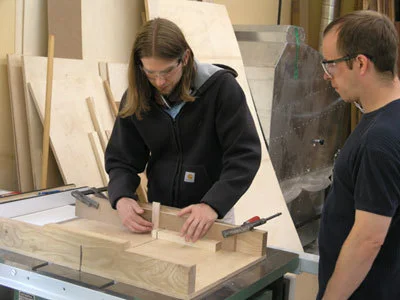
Ian demonstrating to Mark the safe operation of cutting shoulders of tenons on the table saw. In this class students are shown the safe setup and use of the band saw, jointer, planer and table saw. Ian shared with the group the selection of materials including grain graphics followed by a millwork exercise which combines the safe use and operation of the basic woodworking machines with efficiency.

Yvonne demonstrating the process of coiling a bandsaw blade. Yvonne has spent a lot of time in the shop with Robert over the 19 years they have been together.

Mark making initial shavings on his tuned up spoke shave. Students discover that hand tools essentially come as kits and require tuning, sharpening and setup before use. Once complete the tools are a joy to use and provide the woodworker with a surface ready for finish.

Paul setting the knives on the planer. Once the knives are received from the sharpener, they receive a micro bevel which increases durability. The micro bevel is finished off on an 8000 grit water stone, leaving a lovely finish on even the nastiest material.

Robert demonstrates to the group setting up of feed rollers, chip breakers and pressure bars on one of our planers. Following the demonstration, each student is given the opportunity practice skills covered and observe the improved performance of a machine well tuned and maintained. Trouble shooting strategies are discussed to prepare students for potential problems they might expect in their own shop.

From the left: Mark, Paul, Ian & Robert
-
June 26, 2006

Our six-week Artisan Program students were introduced to the applications, making and installation of knife hinges. Ian also gave our Artisan students a half day session on sketching and design. Our resident craftsman offer students another perspective and broad knowledge base.

Federico, one of our resident craftsman shared with students his passion for wood and his interest in parquetry. Our students benefit a great deal from our resident craftsman. Federico brought a half log he found on the beach to the school where it was split. Robert is using a portion of the spalted maple for a commission. The rest of the piece will be made of local cherry.

Our mechanical veneer press has been a side project for Gary and Robert during the final months of the craftsman program. Now complete students will have the opportunity to learn another method for pressing veneer.

Jim and Owen display their tulip wood scraper planes. Just a few of many tools made throughout their time at the school.

On Wednesday of this week we said farewell to one of our graduating craftsman and dear friends. Students, past and present, family and friends gathered at our favorite beach and enjoyed each others company. Michael has been with the school since its inception and will be sorely missed. Michael and Julie Mulrooney are relocating to Twain Harte, California to be closer to family where Michael intends to set up a shop and begin independent work. We look forward to Michael’s return we he takes part in our journeyman program at the school.

Our Artisan Program students took full advantage of the ample extra hour made available to them at the school. As a result drawer making and fitting was added during the last week. We are pleased that Jim Budlong, who was one of Robert’s teachers while at the College of the Redwoods will be joining us for a full week of drawer making and fitting August 14-18. With limited space available, don’t miss this opportunity to learn this important aspect of our craft by one of the finest craftsman and teachers today. Call our toll free number (877) 943-9663.

Jim, from Germany displays four of the planes made during his six weeks at the school. Jim’s family joined him for his last week at the school and took advantage of the wonderful weather and scenery here on the Sunshine Coast.

Families contribute a great deal to the warm and relaxed atmosphere here at the school. From left: back row: Stephen, Owen, Robert, Jim & Ian. Back row: Tadi (Robert’s daughter), Francis & Lucas (Jim’s children)
-
June 19, 2006

Owen pours molten lead into plaster casting mold. After being introduced to the use of ducks, or spline weights, for laying out curves. Jim and Owen took it upon themselves to cast a set for themselves. Tool making continues to be a enjoyable activity at the school and one which our students continue to embrace. The original set of ducks were given to the school as a gift from our friends Ejler Hjorth-Westh and Todd Sorenson, two of the College of the Redwoods faculty.

The first duck coming out of the mold. Made from recycled tire weights and the mold made of plaster of Paris.

Jim and Owen and the first ‘duck’. Well done. Braising rod will be used to create a hold down hook for the spline before receiving a plastic coating and leather pad.

Curved veneer panels in the vacuum press. A great deal of work goes into the making of a curved door. Students learn a variety of hand and machine methods involved in this process.

Jason shares with the class the inspiration for his showcase cabinet complete with curved veneered marquetry panels and curved glass.

Owens tapered laminations in dry run. A challenging method done very well!

Tapered Laminations complete with sled, and shop drawing along with a few of the hand tools used to create them. The curve is laid out and transferred to a piece of poplar which is cut on the bandsaw and shaped using spoke shaves and hand planes and flaw board is applied. Measurements are extracted from the finished form and a sled is created to taper each of the laminates that have been resawn on the band saw. Test passes are made and the sled is refined until the laminates fit the form perfectly.

Jason demonstrates double bevel marquetry method to our students. Alumni continue to be our schools most cherished resource. Jason has developed into a very fine craftsman and we expect big things from this young man in the coming years.

Each student had the opportunity to make a curved veneered panel. The three pictured are at different stages. Each panel consists of 11 pieces of wood. We begin by by laying out and refining a template which is transferred onto a piece of 8/4 poplar. The poplar is hand planed to shape, flaw board is applied and a core or three layers of Italian bending plywood is laminated on the form in the vacuum press. While the core is in the press, students are given a piece of eastern hard maple. Edges to be applied are removed prior to cutting the veneers on the band saw. Once out of the press, ‘baked in’ edges are applied and flushed to the core using smoothing and coopering planes. The panel returns to the press and receives veneers that have been cleaned up by hand using hand planes and scrapers. The panels sides are cleaned up with a jointer plane before applied edges are applied. The edges, also shot with a hand plane the applied, leaving a virtually invisible joint. All surfaces are hand planed and edges softened.

We finish off the week coopering. Students are taught the process of edge jointing using hand planes and encouraged not to use the jointer. They are then shown the process of beginning the shaping prior to gluing up the staves two at a time. With the panel glued up students use coopering, jointer and smoother planes to shape and taper as desired.

Jim and Owen have been a lot of fun and have made remarkable progress as craftsman. They have also been a delight to have as students. Our first six week Artisan Program wraps up this week, they will be dearly missed and we will look forward to their return.

Artisan E – Veneers & Curves. From left, Tom, Robert, Owen and Federico. Jim was away for the
pictures. He has gone to pick up his family arriving from Germany to join him for the final week of the Program. -
June 12, 2006
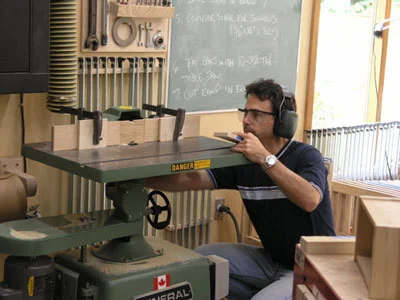
Jim setting up the shaper for rabbet. Jim has developed that sensible balance we strive for at the school. The balance between the use of hand and machine tools. Jim’s family are coming from Germany to spend the last week of the six week Artisan Program with him.

Owen cleans up his cabinet after initial glue up. Owen is also taking our six week Artisan Program. Owen and Jim have taken advantage of the many evening and weekend hours at the school and have managed to make several tools including: planes, spoke shaves, chair scrapes, shooting boards, chopping blocks and bevel gauges. In addition they have been exposed to and have had the opportunity to develop many of the skills covered in our Craftsman Program.

Terry, from A & M Woods and his wife Cathy dropped by the school for a visit. Terry was a tremendous help to our students this past year. Terry, an accomplished craftsman in his own right has a good eye for wood and sourced out wood for our students on a number of occasions this past year.

Jamie, discovers the sport of free hand mortising. Jamie commented on the first day that his experience at InsidePassage last year opened his eyes to a whole new world of possibilities. Jamie has donated a computer to the school for students to check their e-mail and source out materials. We will look forward to his next visit.

Federico, one of our resident craftsman shares his thoughts on partitions. The students benefit a great deal from having resident craftsman at the school. Students coming for even one of our one week courses have the opportunity to observe skilled craftsman working at their craft.

Mark using one of the schools wooden jointer planes to shoot the edge of the frame and panel back as he fits the back to the doweled cabinet. In this one week program students had the opportunity to construct a small wall cabinet of doweled construction and fit it with a frame and panel back. Students prepare the surfaces and edges with planes and files.

Ian explains to the students the cleanup and fitting of a tenon. Ian is also one of our resident craftsman and teachers at the school. Ian has a strong aesthetic and has developed into a fine craftsman. His relaxed thorough teaching style is appreciated by our students.

Artisan D, Joinery from left Back row: Ian, Mark, Jim, Owen, Robert & Jamie. Front Row Coulter & Federico.

A birthday at Inside Passage. Federico leads the class in Happy Birthday in Spanish. Federico’s wife Veronica, a dear friend celebrates her first birthday in Canada.
-
June 5, 2006
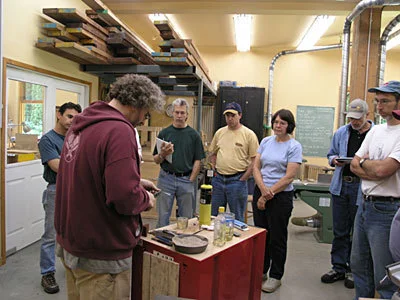
Robert demonstrates the process of making chisels. Students begin with an old file, which is a good source for carbon steel. Next they are given the opportunity to anneal or soften the steel, then cut, shape and flatten the tool, then harden and temper the steel. Each student made a paring chisel fitted with a handle of cocobolo. A few of the students made several chisels including paring, dovetail, small bevel edge and even a crank necked chisel.

Brent, one of our returning students this summer, fits a Jatoba wear plate to his shooting board. Each of our students made a shooting board which was used during the class. A number of processes were covered including cutting tapers on the bandsaw and the “sport” of free hand mortising.

Tools and fixtures made in this program are used throughout the week when students are taught the layout, cutting and fitting of both through and half lapped dovetail joinery. Shown here are just a few of the tools made, and the dovetail joints cut throughout the week. The small bevel gauge is new and will now become part of the curriculum in both the Artisan and Craftsman Programs taught here at the school. The body is cocobolo, the blade is Jatoba and features a brass knurled knob that allows adjustment within the range of angles used in the layout of dovetails.

Following the week we were joined by friends, family, students past and present for an Elephants at the school. Brent, one of our graduates from Washington even made the trip.

Artisan – C Dovetails & Tool Making. Back row from the left. Bruce, John, Robert, Brent, Glenn, Paul & Mitch. Front row from left, Owen, Jim, Marlene and Cody.
-
May 29, 2006

A few tools made this week at the school. Each student had the opportunity to make a smoother and jointer plane, a wooden spoke shave and a wood & brass chair scrape. The little wooden square was a side project for Paul put together with an open mortise and tenon joint. Also shown is a compass plane Robert made during the demonstration of Plane Making.

Paul using a gouge to carve finger placements on his wooden smoother. Paul is a independent craftsman visiting from Whitehorse, Yukon refining his already good hand skills.

Owen from Fort McMurrey, Alberta completing the shaping of his wooden smoother. Owen is one of our six week Artisan students. Next week he will join a full class as we explore further tool making and dovetail joinery.

Jim from Kronberge, Germany takes his first shavings with the first of two planes he made during this week. Once planes where complete Michael took the students through the ‘right of passage’ perfect board exercise.

Artisan B – Plane Making & Surfaces. From Left Owen, Paul, Jim & Michael. This is Michael’s final week at Inside Passage as a Resident Craftsman & Teacher. He will be sadly missed but we look forward to his return as a guest teacher.
-
May 22, 2006

Artisan A – Introduction to Hand & Machine Tools this week included students from Germany, Alberta and British Columbia From left are Gary, Owen, Marlene, Geoff and Jim.

In addition to thirty years experience as a independent Craftsman Gary has a terrific sense of humor which he brings to the table when he teaches. We are very fortunate to have Gary as our relief teacher at the school.

Robert joined the class for a half day and shared with the class the tuning and use of hand planes. Owen and Jim taking part in our six week Artisan Program. Artisan Program students enjoy the benefit of evening and Saturday hours at the school.

Jim from Germany is shown the art of shaving ones forearm with a razor sharp iron. In Artisan A, students are introduced to Hand and Machine tools and are encouraged to develop a sensible balance between them.